See how Opendate can help you manage the entire event lifecycle.
Let us know who you are to unlock the demo video.
Thank you! Your submission has been received!
Oops! Something went wrong while submitting the form.



















| Feature | Opendate | Eventbrite |
|---|---|---|
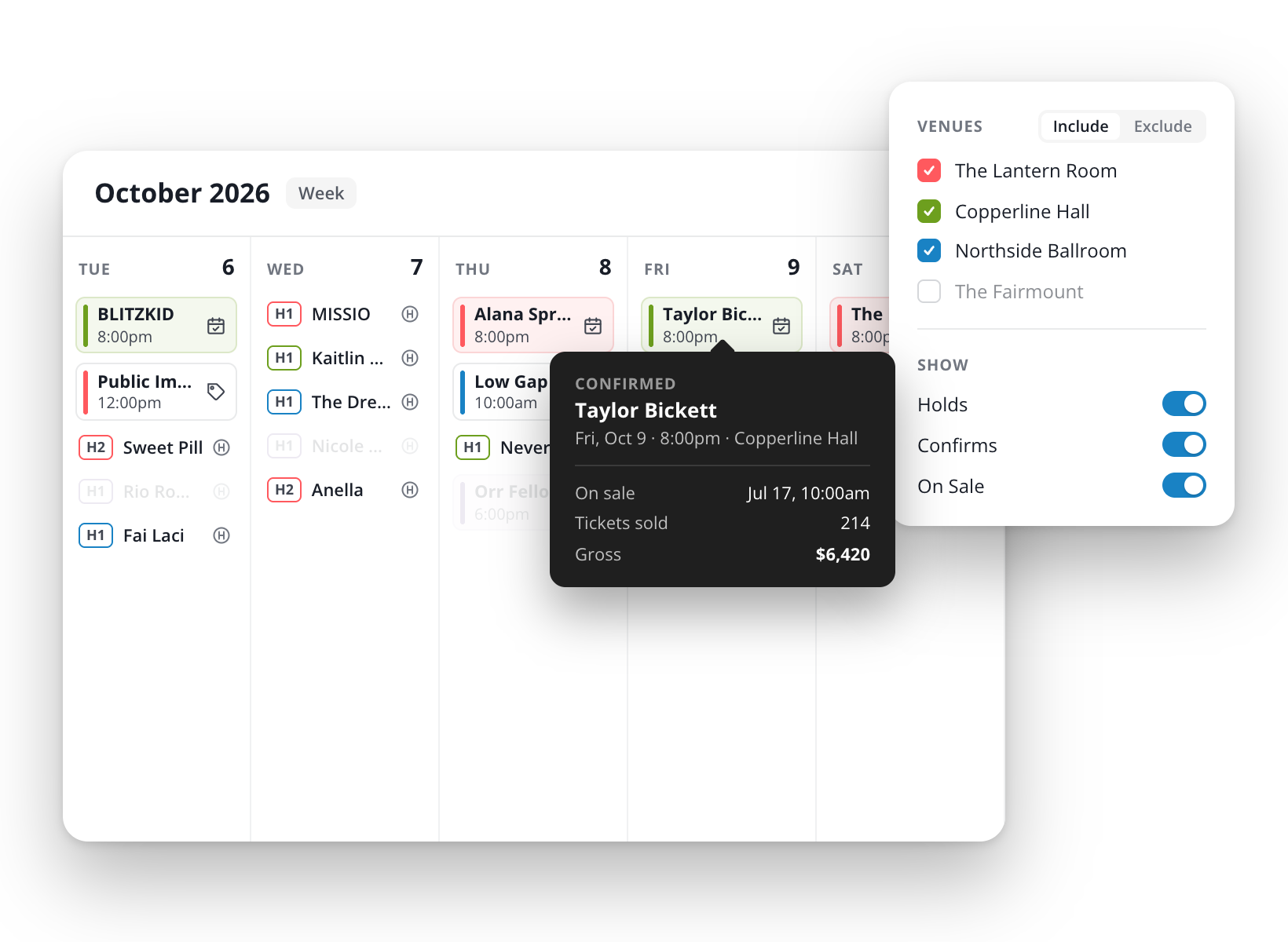
| Booking calendar, avails | ✓ Multi-venue calendar. Avails you can paste to an agent | ✕ Not included |
| Date holds | ✓ Ranked holds that auto-promote, multi-date | ✕ Ticket and seat holds on an event that already exists. Not date holds |
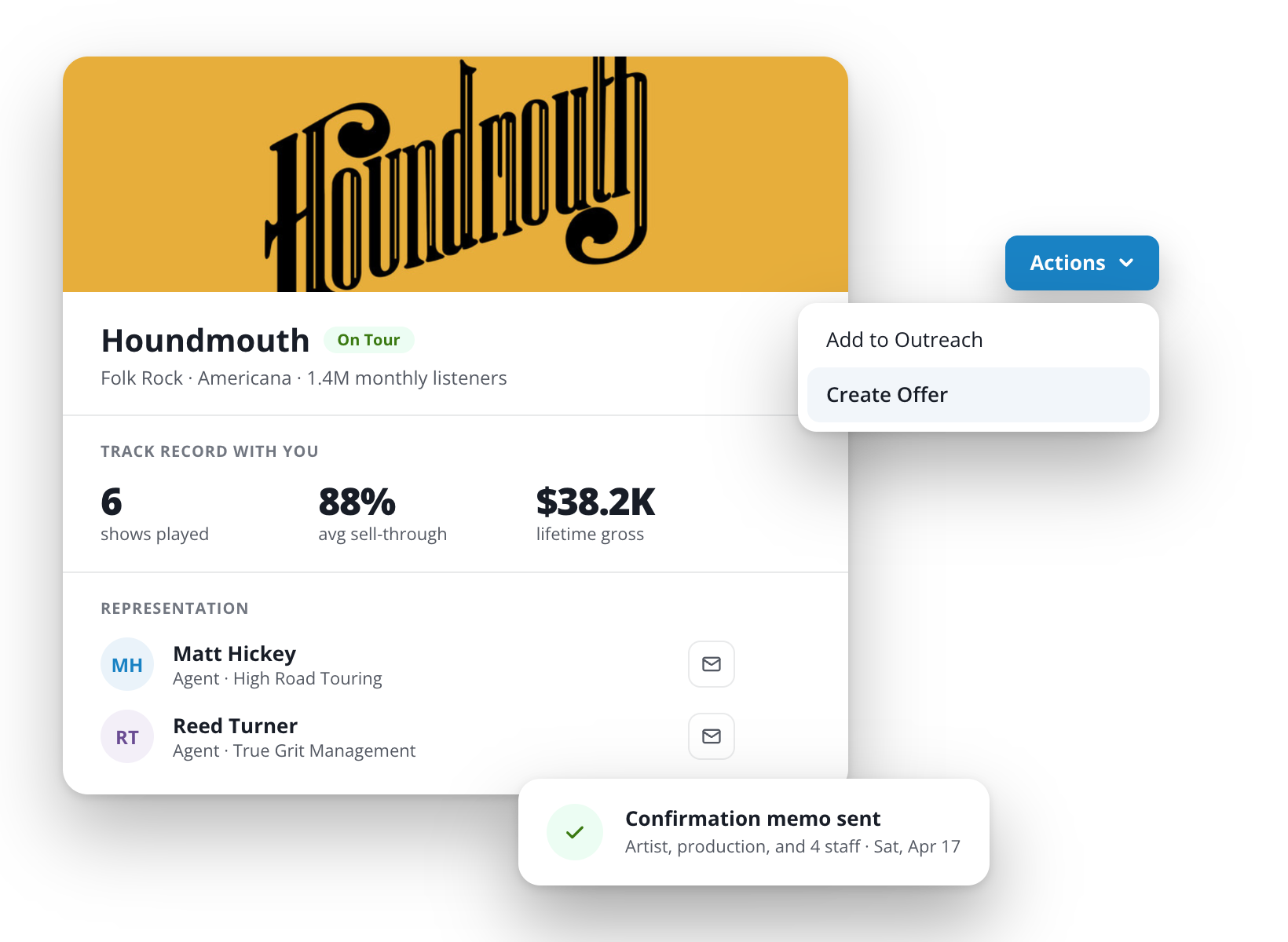
| Artist offers | ✓ Templates with splits, bonuses, comps, kills | ✕ Not included |
| Advance and run of show | ✓ Advance templates, guest lists, day-of detail | ✕ Not included |
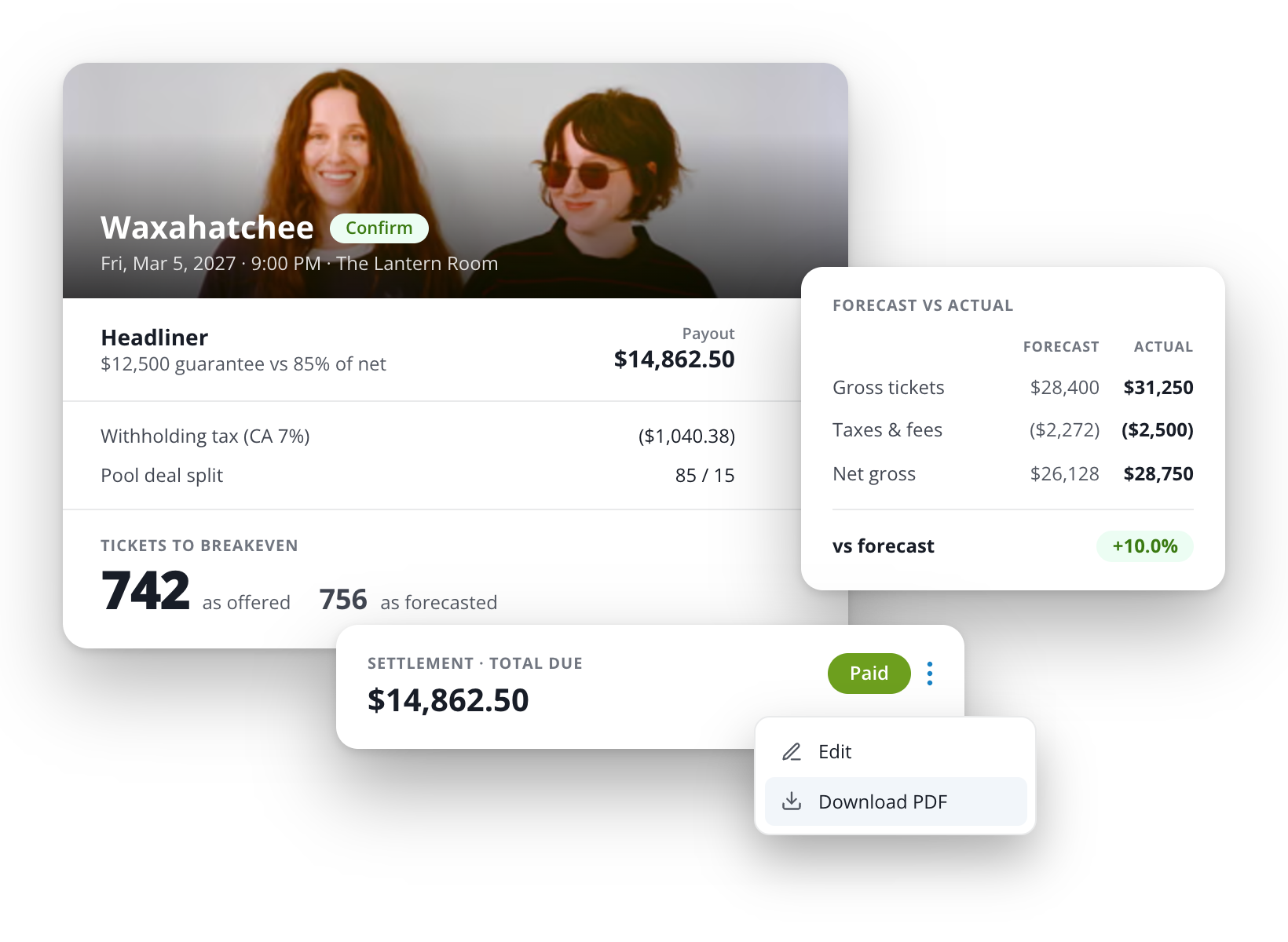
| Artist settlement | ✓ One click, off the offer plus live counts | ✕ Not included |
| Show P&L | ✓ Forecast, actuals, tickets-to-breakeven before doors | ✕ Revenue reporting. No event-level cost or breakeven published |
| Ticketing and entry | ✓ GA, add-ons, promo codes, mobile entry | ✓ Ticket types, promo codes, timed entry, Organizer app check-in |
| Reserved seating | ✓ GA and reserved. Charts built in 3–5 days | ✓ Self-serve seat maps, pricing by section or seat. A real strength |
| Marketplace discovery | ✕ No consumer marketplace. Distribution pushes events to partner platforms | ✓ 89M monthly users, and they attribute about 30% of tickets to it. Stronger |
| Fan CRM and owned channels | ✓ Genre, spend, automated segments. Email, SMS, push built in | ✕ Email campaigns and three automatic lists. No SMS published |



Avails, ranked holds and the artist offer live on the record that sells the ticket, so the deal you sign carries its ticket types, comps, kills and announce dates into the on-sale. Eventbrite has holds, but they hold tickets and seats on an event that already exists, and no booking calendar sits behind them.
Advance templates go out from the show page, and guest lists, tech details and day-of notes come back to it, so production, the box office and the artist work from one version. Eventbrite publishes no advance or run of show, so that coordination happens outside the system selling the ticket.
Splits, bonuses and comps calculate against live door counts, off the offer you already agreed, so the artist signs before load-out. Eventbrite's product ends at the checkout, so the settlement happens wherever you keep your spreadsheets.
Forecast, actuals and tickets-to-breakeven sit on the show page next to the offer, so you price the guarantee against the room. Eventbrite reports revenue, tickets sold and traffic. No cost, profit or breakeven appears in its documentation.


Moved from Eventbrite in 2025. Sold VIP, merch and parking on the same ticket and grew 34% year over year, to 17,000+ tickets, run entirely by volunteers.
“We loved that we could work with one organization for ticketing, talent, and long-term marketing support. It helps us scale without adding overhead.”
No. Eventbrite's published product starts at event creation and runs through discovery, checkout and entry. A booking calendar, avails, ranked date holds, artist offers, the advance and artist settlement don't appear in it. On Opendate all of that sits on the same record that sells the ticket, ten weeks before the on-sale.
Not in the sense a talent buyer means. Their help centre describes a hold as removing tickets from sale so you can release them later or give them to specific people, and it applies to tickets or seats on an event that already exists. A booking hold is a claim on a date before there is an event, ranked against competing holds and promoting when a higher one drops. Opendate has both; Eventbrite publishes only the first.
There was, and it's worth knowing where it stands. Eventbrite Music still has help documentation, but their help centre states they aren't currently accepting new customers to it or adding it to existing accounts. If a salesperson references it, ask directly whether you can actually buy it. What is current and music-specific is their Lineup tool, which publishes artist profiles out to Spotify, Bandsintown and Songkick. That's a listing feature, not a booking one.
You'd lose that marketplace, and it's the strongest thing they have. Eventbrite publishes 89 million monthly users and attributes roughly 30% of tickets sold to its own discovery. Take that seriously. Opendate doesn't run a consumer marketplace, so the honest comparison is between rented demand and an owned list. Opendate Distribution pushes your events out to partner ticketing platforms, and the fan who buys lands in a CRM you can sell the next show to. If discovery is the whole job and you have no list to build, Eventbrite is the better buy.
Both are theirs and both are good. Eventbrite's seat maps are self-serve, mix GA with reserved, and price by section or individual seat, with no plan gate published. Timed entry handles daily slots for recurring events. Opendate sells GA and reserved and builds your charts in 3 to 5 days, with the constraint that they can't be adjusted after an on-sale. For a seated room that reconfigures often, weigh that properly.
We won't characterise their position, because Eventbrite publishes no ownership statement on its product or help pages. Ask them directly and get it in writing. What they do publish is a full attendee export to CSV or Excel, which is a fair position. The difference is what the record does next: on Opendate the buyer arrives with genre affinity, purchase history and lifetime spend attached, and you market to that from the same login.
Email campaigns with templates, scheduling, automatic reminders and open-rate tracking, which covers the basics well. Two things to check against how you actually work. Their subscriber lists are three automatic ones, All Subscribers, Unsubscribed and Purchasers, and the Purchasers list holds attendees who opted into your marketing at checkout rather than everyone who bought. And SMS doesn't exist. As of their April 2026 roadmap post, Eventbrite describes direct SMS as something they're exploring. Opendate includes email, SMS and push, scheduling off the confirmed offer.
Not on Eventbrite. Their analytics cover revenue, tickets sold, sales by ticket type, traffic and conversion, which is solid revenue-side reporting. No event-level cost tracking, profit view or tickets-to-breakeven appears anywhere in their documentation. Opendate puts forecast, actuals and tickets-to-breakeven on the show page next to the offer, so you price the guarantee against the room before you confirm it.
Nothing on sale has to move. In-flight Eventbrite events sell through untouched, and the externally ticketed event type keeps your calendar and reporting whole through one overlapping on-sale cycle. Calendar import runs about a week, the fan list comes across with it, ticketing cuts over show by show, and seating charts take 3 to 5 days.
Then most of Opendate is overhead you won't use, and we'd rather say so. If the room is rented, the promoter brings the show, and your job is selling tickets and scanning them at the door, Eventbrite covers that and brings demand on top. The case for Opendate starts the moment holds, offers, advances and settlements become your problem, which for most rooms is sooner than they expect.