See how Opendate can help you manage the entire event lifecycle.
Let us know who you are to unlock the demo video.
Thank you! Your submission has been received!
Oops! Something went wrong while submitting the form.





| Feature | Opendate | AXS |
|---|---|---|
| Booking calendar, avails | ✓ Multi-venue calendar. Avails you can paste to an agent | ✕ Not included. The published lifecycle starts at event setup |
| Date holds | ✓ Ranked holds that auto-promote, multi-date | ✕ Ticket reservations pending payment, not holds on a date |
| Artist offers | ✓ Templates with splits, bonuses, comps, kills | ✕ Not included |
| Advance and run of show | ✓ Advance templates, guest lists, day-of detail | ✕ Not included |
| Artist settlement | ✓ One click, off the offer plus live counts | ✕ Not included |
| Show P&L | ✓ Forecast, actuals, tickets-to-breakeven before doors | ✕ Not included. Reporting covers sales, scanning, demographics |
| Ticketing and entry | ✓ GA, add-ons, promo codes, mobile entry | ✓ Mobile ID, RFID, multiple access control rules. Stronger |
| High-demand on-sales | ✓ Per-card caps, max per fan, reCAPTCHA, 2FA | ✓ Waiting rooms, lottery allocation, bot defence. Stronger |
| Reserved seating | ✓ GA and reserved. Charts built in 3–5 days | ✓ 2D and 3D plans at arena scale. Deeper |
| Fan CRM and owned channels | ✓ Genre, spend, automated segments. Email, SMS, push built in | ✕ Marketing run as a managed service. No self-serve builder published |
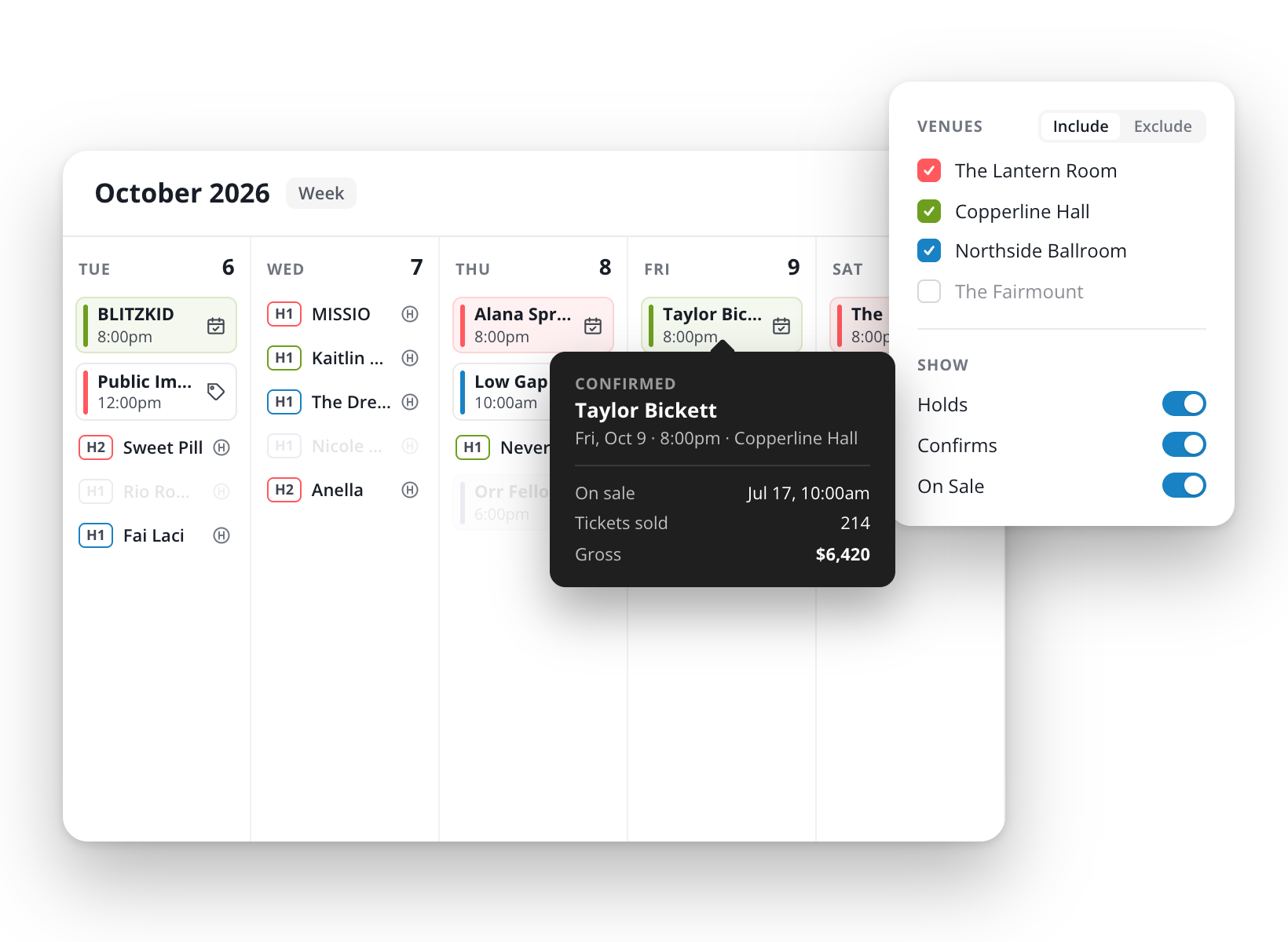
Avails, ranked holds and the artist offer live on the record that sells the ticket, so the deal you sign carries its ticket types, comps, kills and announce dates into the on-sale. AXS describes its lifecycle as beginning at event setup, which means the show already exists before their system sees it.
Advance templates go out from the show page, and guest lists, tech details and day-of notes come back to it, so production, the box office and the artist work from one version. AXS publishes no advance or run of show, so that coordination happens outside the system selling the ticket.
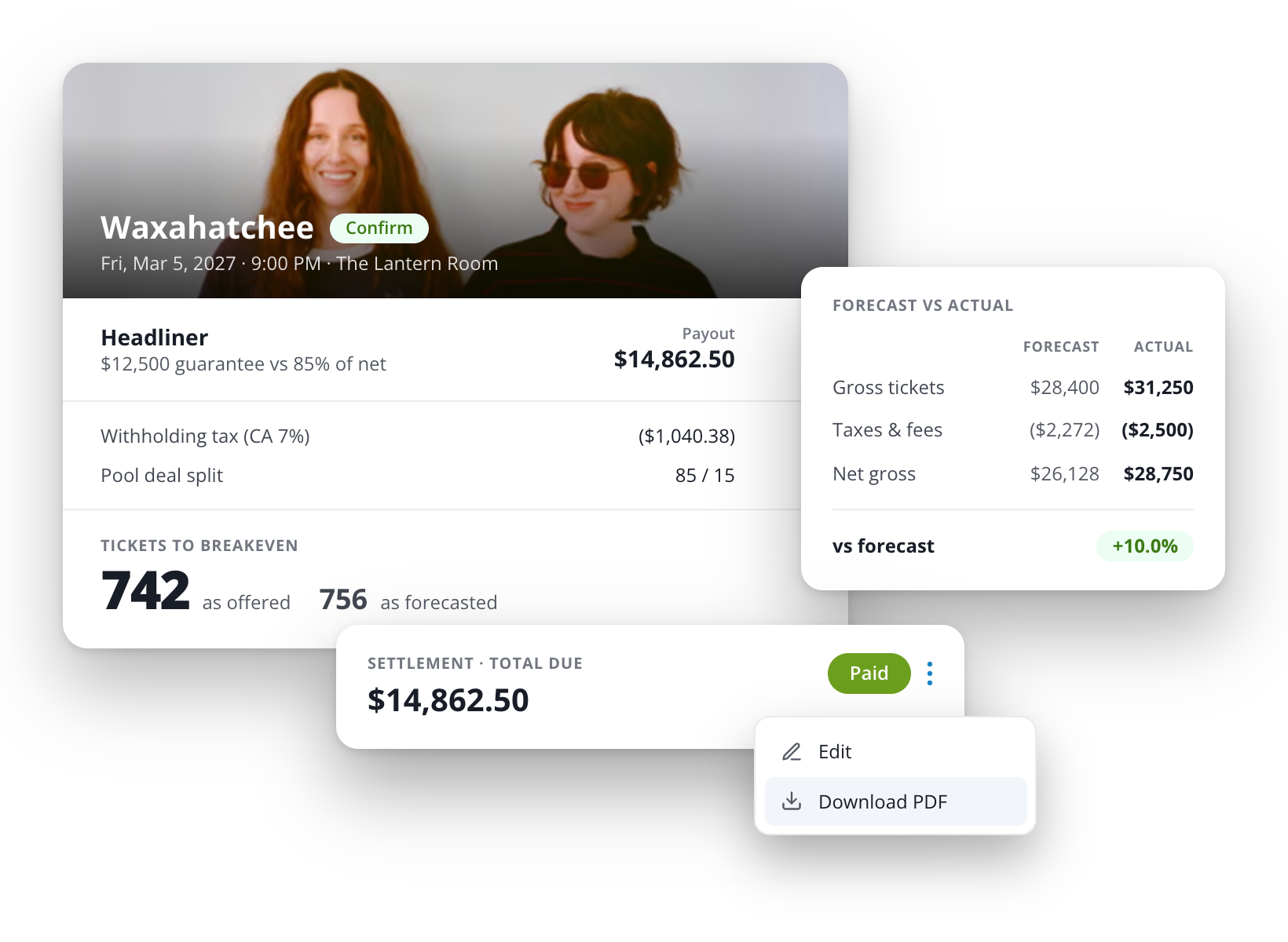
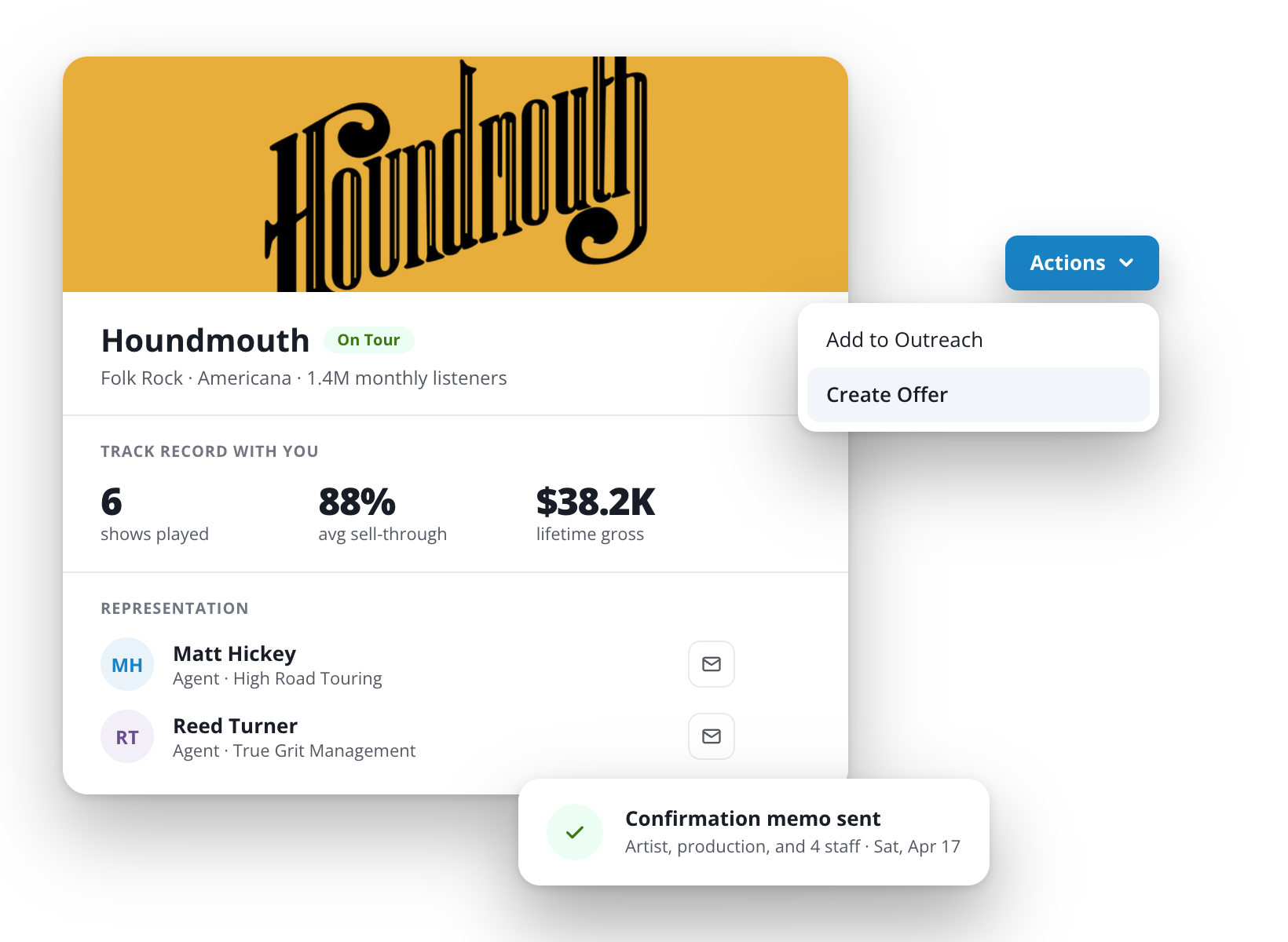
Splits, bonuses and comps calculate against real sales, from the same record that holds the offer you agreed to, so the artist signs before load-out. At 20 Front Street, work that used to take over an hour now takes minutes.
Forecast, actuals and tickets-to-breakeven sit on the show page next to the offer. You price the guarantee against the room instead of finding out when the settlement sheet comes back.


7 venues, 433 events, one platform. Unique fans up 531% at Hook & Ladder.
“Opendate has transformed our company. We are a better live event business than we were before Opendate.”
No. AXS publishes Venue Operations, Venue Experience, Data & Analytics, Marketing Services and Consumer Experience. A booking calendar, avails, artist offers, the advance and artist settlement appear on none of them. Their own framing is that the process runs from event setup forward, which is the moment a show already exists. Opendate starts ten weeks earlier, when the date is still a hold.
Not in the sense a talent buyer means. What AXS publishes is a fan reserving tickets with a payment link, which is an inventory reservation. A booking hold is a claim on a date before any show exists, ranked against competing holds and promoting automatically when a higher one drops. Opendate has both; AXS publishes only the first.
This is AXS at its best, and it would be silly to pretend otherwise. Waiting rooms, lottery and draw allocation, bot defence and Mobile ID credentials that rotate are built for the night 20,000 people refresh at once. Opendate has per-card caps, max-per-fan limits, reCAPTCHA and 2FA, which suit a room selling hundreds to a few thousand. If your hardest night is a stadium on-sale, take their call.
Also theirs. AXS publishes RFID, multiple access control rules and contactless entry that works without a signal. Opendate scans on devices your staff already carry. For a gated stadium with many entry points, that difference is real. For a room with two doors, it stops mattering and the booking side starts to.
We're not going to characterise their terms, because AXS publishes no statement about it. Their pages describe reporting and analytics access rather than ownership or export rights, so ask them directly and get it in writing. On Opendate there is nothing to ask: the record is yours, segmented by genre affinity, purchase history and lifetime spend, and you market to it from the same login.
The buyer transacts in an AXS account and carries an AXS Mobile ID across every venue using it, with entry, upsells and in-venue payments running through that app. That brings cross-venue discovery, which is a real benefit. It also means the primary relationship is with the platform. Opendate ships an app under your own App Store listing, sending your own push notifications.
As a managed service. They publish ECRM, affiliate and paid social support, with AXS doing the work. That suits a team without marketing staff. What isn't published is a self-serve campaign builder or an SMS channel, so you don't schedule your own announce sequence. Opendate includes email, SMS, push and segments that build themselves, scheduling off the confirmed offer.
AXS quotes per client and doesn't publish rates, so ask for the full schedule including payment processing before you compare anything. Opendate publishes its tiers: Opener free, Marquee from $4K a year, and Headliner free with ticketing. All-In Pricing shows the fan the total before checkout.
Nothing on sale has to move. In-flight AXS events sell through untouched, calendar import runs about a week, ticketing cuts over show by show, and seating charts take 3 to 5 days. Check your term and notice window before you plan a cutover.
Then AXS is likely the right answer and this page isn't for you. Their throughput tooling, access control and seat maps are built for that scale, and Opendate is not trying to serve a 20,000-seat building. The case for Opendate starts in the room that books its own calendar, cuts its own offers and settles its own artists.