See how Opendate can help you manage the entire event lifecycle.
Let us know who you are to unlock the demo video.
Thank you! Your submission has been received!
Oops! Something went wrong while submitting the form.






| Feature | Opendate | Etix |
|---|---|---|
| Calendar, avails, holds | ✓ Multi-venue calendar. Ranked holds, auto-promote, multi-date | ✕ Not included |
| Artist offers | ✓ Templates with splits, bonuses, comps, kills | ✕ Not included |
| Advance and run of show | ✓ Advance templates, guest lists, day-of detail | ✕ Not included |
| Artist settlement | ✓ One click, off the offer plus live counts | ✕ Not included |
| Show P&L | ✓ Forecast, actuals, tickets-to-breakeven before doors | ✕ Not included |
| Ticketing and entry | ✓ GA, add-ons, promo codes, mobile entry | ✓ Ticketing, mobile entry, fraud detection |
| Reserved and season | ✓ GA and reserved. Charts built in 3–5 days | ✓ Reserved and season ticketing. A real strength |
| Box office, phone sales | ✓ Door scanning on your own devices | ✓ Ships hardware, staffs a phone centre |
| Fan CRM and owned channels | ✓ Genre, spend, automated segments. Email, SMS, push | ✓ Patron management, automated marketing, branded sites |
| Pricing | ✓ Published tiers. All-In Pricing shows the fan the total upfront | Quoted per client |

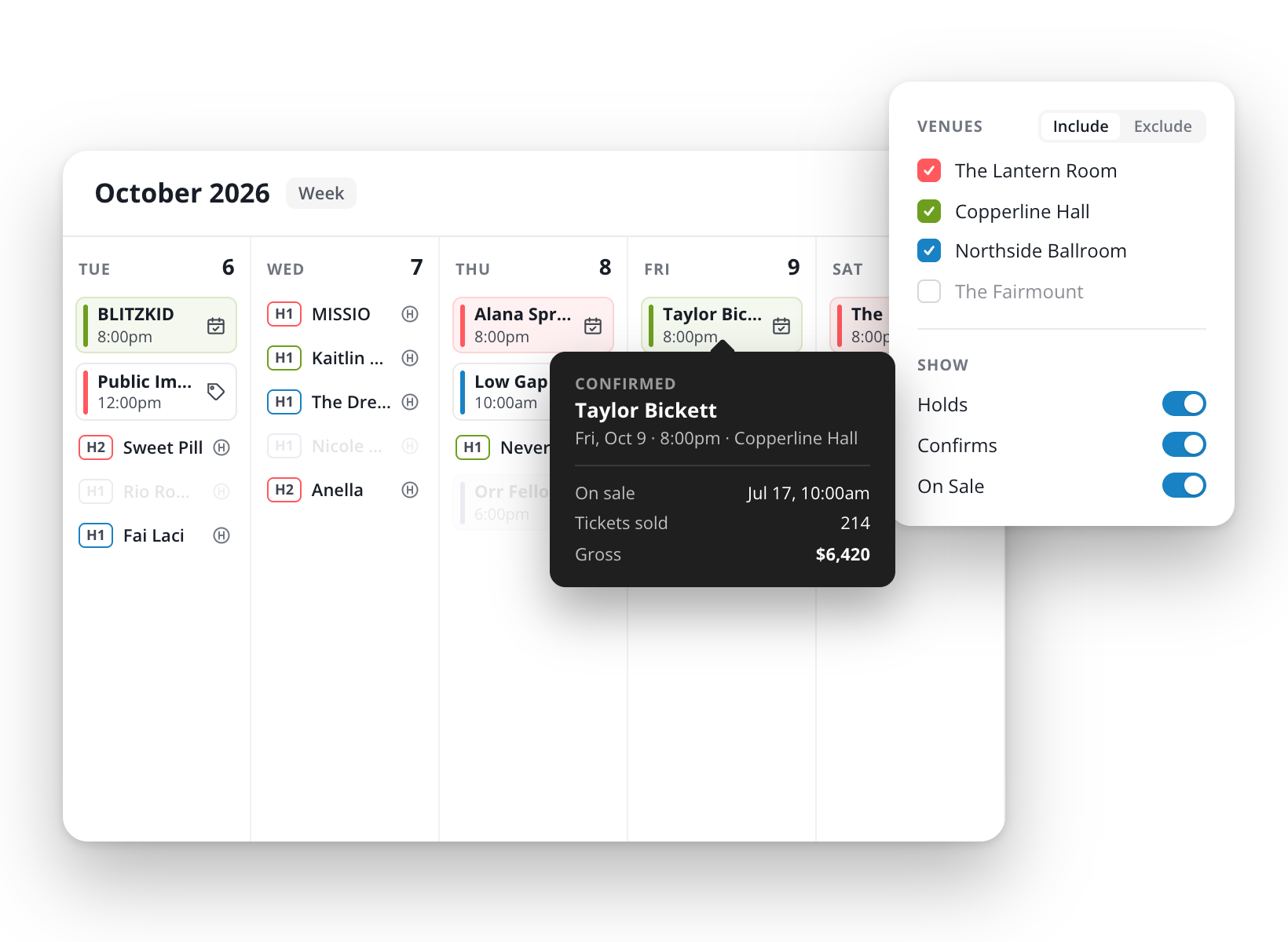
Avails, ranked holds and the artist offer live on the record that sells the ticket. The deal you sign carries its ticket types, comps, kills and announce dates into the on-sale, so nobody rebuilds the show in a second system. Etix starts at the checkout, so everything before it lives somewhere else.
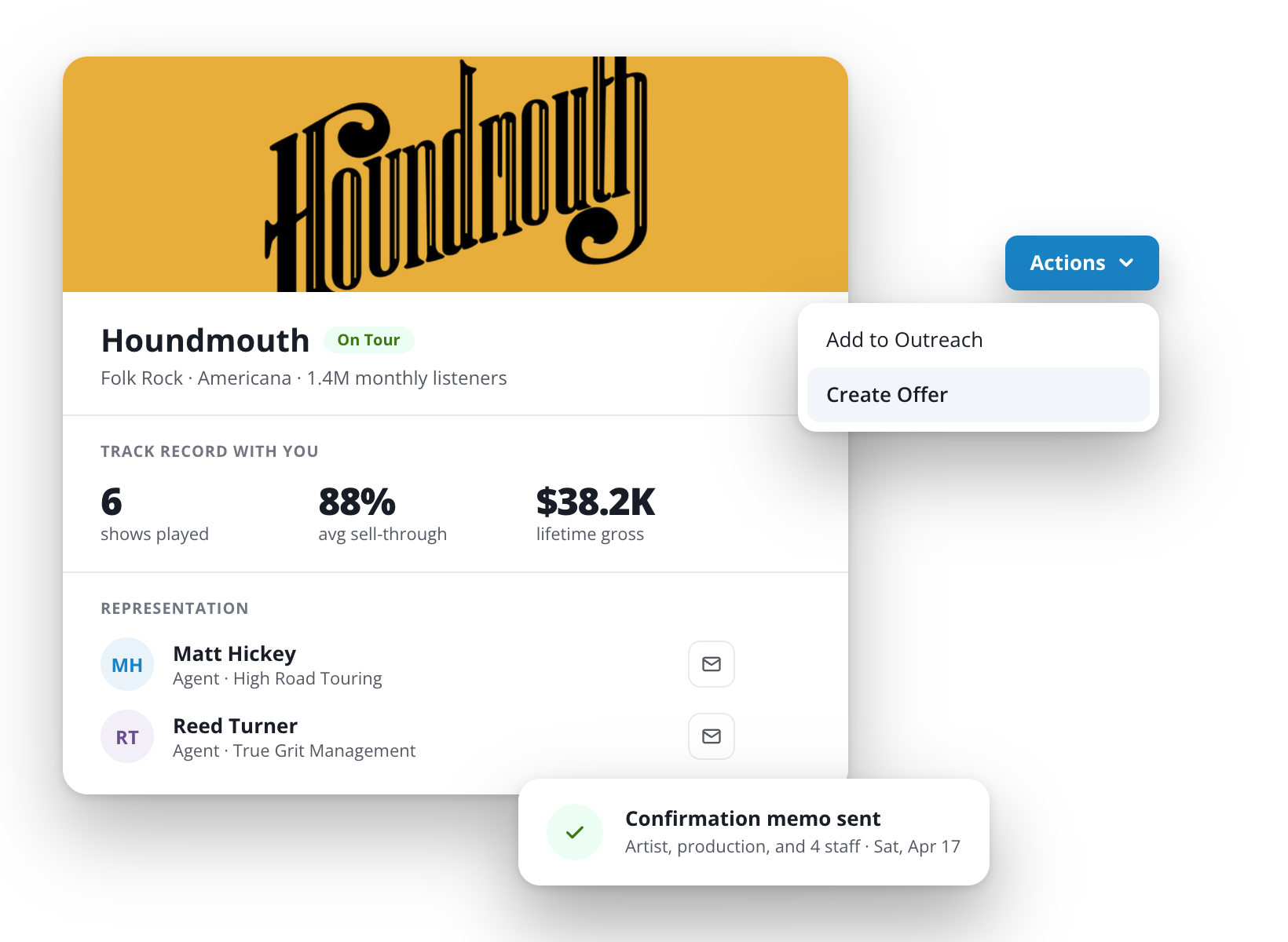
Advance templates go out from the show page, and guest lists, tech details and day-of notes come back to it, so production, the box office and the artist are all working from one version. Etix doesn't include the advance, so that coordination lives outside the system selling the ticket.
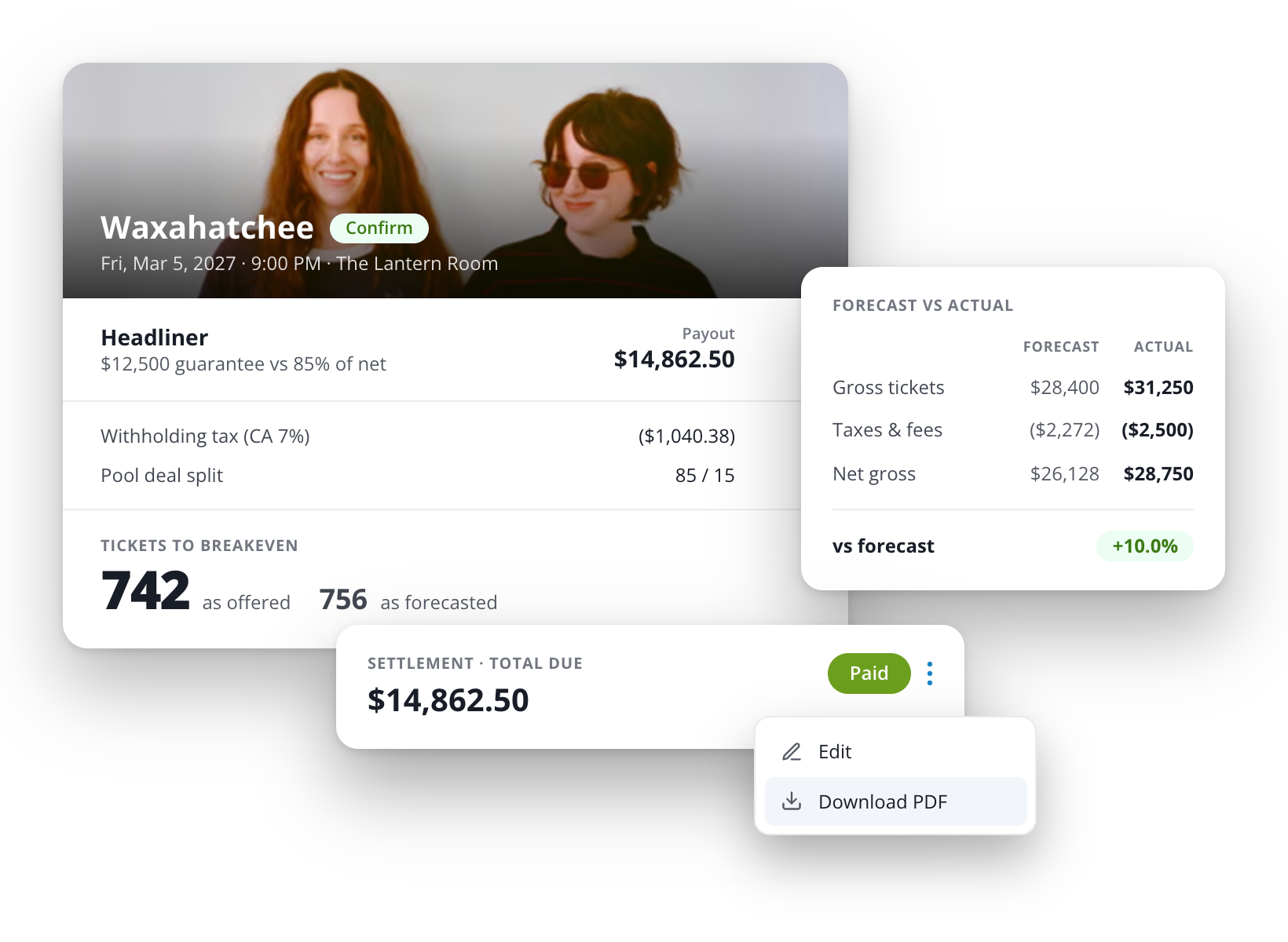
Splits, bonuses and comps calculate against real sales, from the same record that holds the offer you agreed to, so the artist signs before load-out. At 20 Front Street, work that used to take over an hour now takes minutes.
Forecast, actuals and tickets-to-breakeven sit on the show page next to the offer. You price the guarantee against the room instead of finding out when the settlement sheet comes back.


Six disconnected systems and 15 filing cabinets, replaced by one. Ticket sales up 12.5%.
“The visibility alone is transformative. Instead of six systems, now everything, from plots to contracts, is in one place.”
No. Etix's own venue pages describe building events quickly, inventory control, branded websites and marketing, fan data, real-time fraud detection, mobile entry and entry equipment. A booking calendar, avails, ranked holds, artist offers, the advance and artist settlement don't appear on them. On Opendate all of that sits on the same record that sells the ticket.
Yes, and some rooms start that way. Opendate's externally ticketed event type keeps your calendar and reporting whole while Etix keeps selling. What you don't get until ticketing moves is the part that pays off — the accepted offer building the on-sale, and settlement running against live door counts. Most rooms that start split don't stay split.
Etix is strong here. SeatSuite builds detailed seat maps with individual seat selection, and it handles full-season and custom packages. Opendate sells GA and reserved, and we build your charts in 3–5 days. The real question is how much of your year that covers. If you're a subscription house with a fixed season, weigh it carefully. If you're a music room running a hundred-odd shows where a handful are reserved, you'd be keeping a seat map and giving up the calendar, the offer, the advance and the settlement to do it.
Etix supplies entry equipment and services it. Opendate scans on devices your staff already carry, so there's no hardware line in the budget and no lead time when something dies on a Friday — you grab another phone. If a managed equipment contract is something you genuinely rely on, price it in. For most rooms it's a cost that just goes away.
Etix quotes rates per client and doesn't publish them, so ask for the full schedule including credit card processing before you compare anything. Opendate publishes its tiers: Opener free, Marquee from $4K a year, and Headliner free with ticketing. All-In Pricing shows the fan the total before checkout.
Both of you do. Etix states that the venue owns its customer data and that it's used only to sell that venue's tickets, and that's a fair position. The difference isn't ownership, it's what the record does once you have it. Opendate segments the same buyer by genre affinity, purchase history and lifetime spend, then sends email, SMS and push from the same login — no export, no second vendor.
Nothing on sale has to move. In-flight Etix events sell through untouched, and the externally ticketed event type keeps the season's calendar and reporting whole through one overlapping on-sale cycle. Calendar import runs about a week, ticketing cuts over show by show, and seating charts take 3–5 days.
No. The fan list comes across with the calendar import, and the externally ticketed event type keeps your existing season visible in reporting while the switch happens, so you're not starting from zero on day one.
Both platforms cover it. Etix advertises real-time fraud detection, and Opendate includes fraud and chargeback protection. Treat it as table stakes and expect it from anyone selling your tickets — then decide on the things that actually differ, which is everything upstream of the checkout.
Then a good deal of Opendate is overhead you won't use. If the room is rented, the promoter brings the show, and your job is selling tickets and scanning them at the door, Etix covers that and the booking side of Opendate won't earn its keep. The case for Opendate starts the moment holds, offers, advances and settlements become your problem — which for most rooms is sooner than they expect.