See how Opendate can help you manage the entire event lifecycle.
Let us know who you are to unlock the demo video.
Thank you! Your submission has been received!
Oops! Something went wrong while submitting the form.








| Feature | Opendate | Tixr |
|---|---|---|
| Booking calendar, avails | ✓ Multi-venue calendar. Avails you can paste to an agent | ✕ Not included |
| Date holds | ✓ Ranked holds that auto-promote, multi-date | ✕ Seat and inventory holds only. No date hold on a calendar |
| Artist offers | ✓ Templates with splits, bonuses, comps, kills | ✕ Not included |
| Advance and run of show | ✓ Advance templates, guest lists, day-of detail | ✕ Not included |
| Artist settlement | ✓ One click, off the offer plus live counts | ✕ Not included. Documented through a booking partner |
| Show P&L | ✓ Forecast, actuals, tickets-to-breakeven before doors | ✕ Not included |
| Ticketing and entry | ✓ GA, add-ons, promo codes, mobile entry | ✓ Offline scanning, NFC, rotating QR, BOCA printing |
| Reserved and season | ✓ GA and reserved. Charts built in 3–5 days | ✓ 2D and 3D seat maps, season tickets, price levels. Deeper |
| One cart for everything | ✓ Tickets, add-ons, memberships, payment plans | ✓ Tickets, merch, F&B, parking, hospitality. A real strength |
| Fan CRM and owned channels | ✓ Genre, spend, automated segments. Email, SMS, push built in | ✕ 90+ data points, exportable. Email and SMS run through partners |


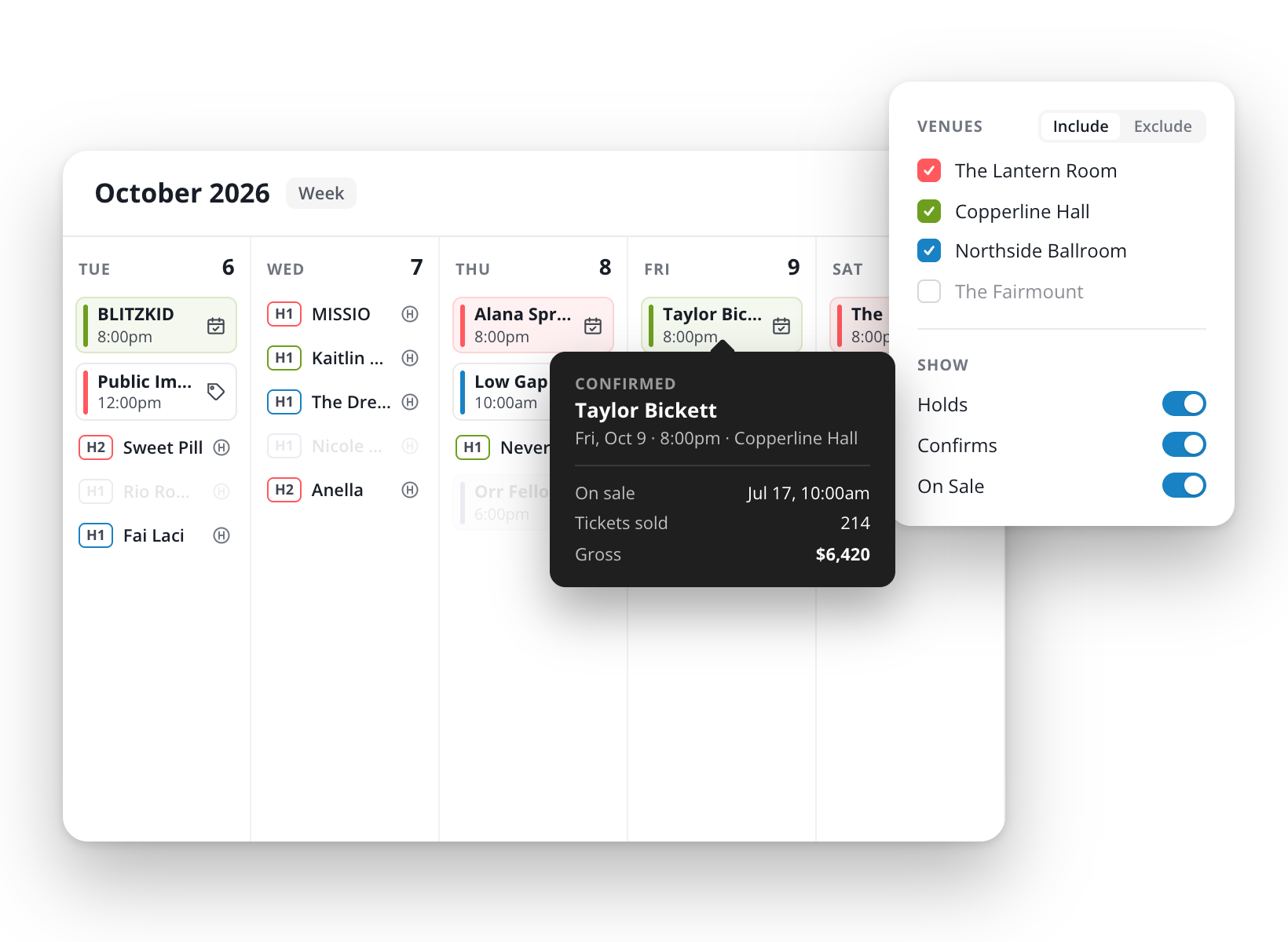
Avails, ranked holds and the artist offer live on the record that sells the ticket, so the deal you sign carries its ticket types, comps, kills and announce dates into the on-sale. Tixr does have holds, but they hold seats and allocations rather than dates, and no booking calendar sits behind them.
Advance templates go out from the show page, and guest lists, tech details and day-of notes come back to it, so production, the box office and the artist work from one version. Tixr publishes no advance or run of show, so that coordination happens outside the system selling the ticket.
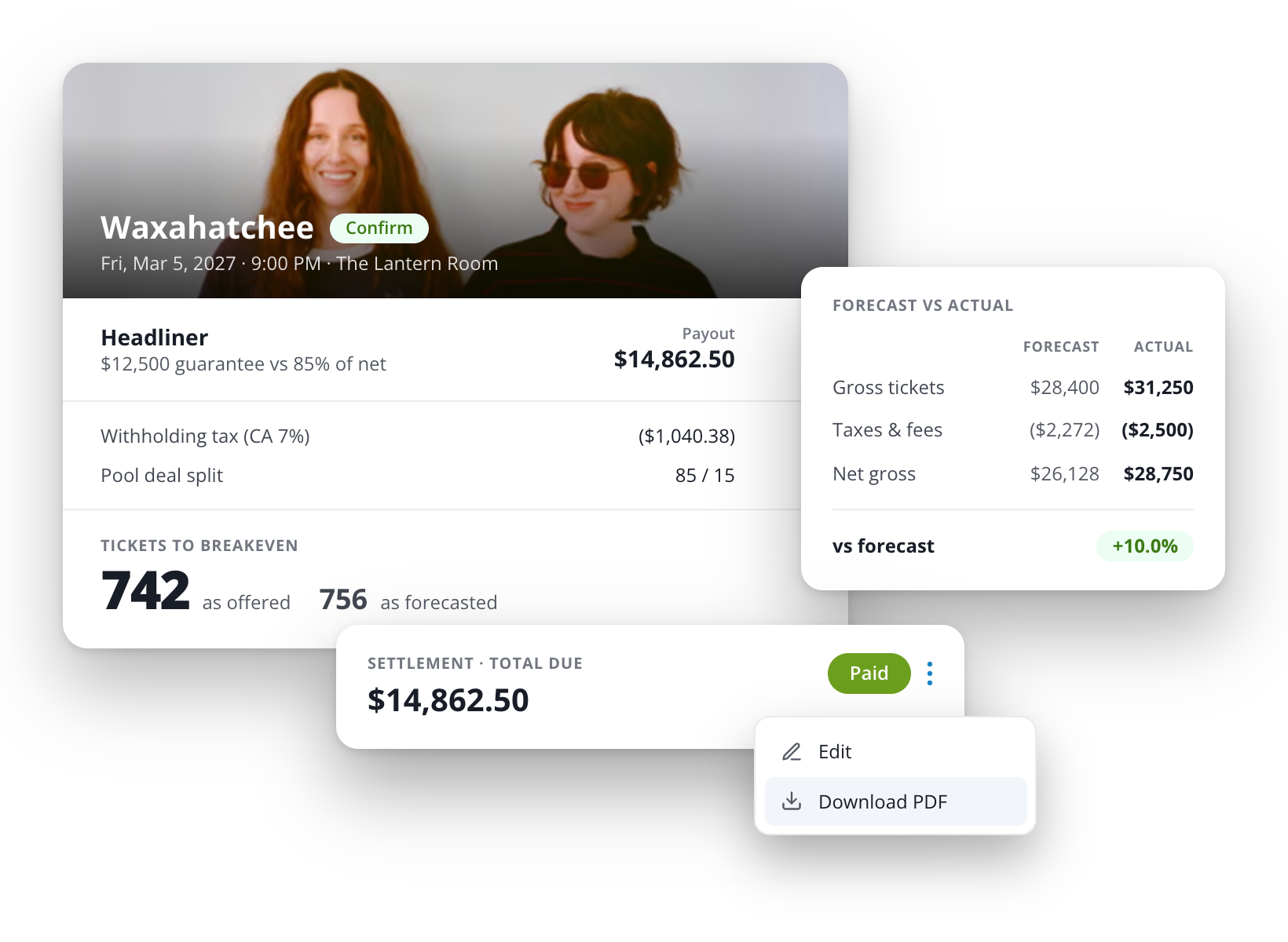
Splits, bonuses and comps calculate against real sales, from the same record that holds the offer you agreed to, so the artist signs before load-out. At 20 Front Street, work that used to take over an hour now takes minutes.
Forecast, actuals and tickets-to-breakeven sit on the show page next to the offer. You price the guarantee against the room instead of finding out when the settlement sheet comes back.
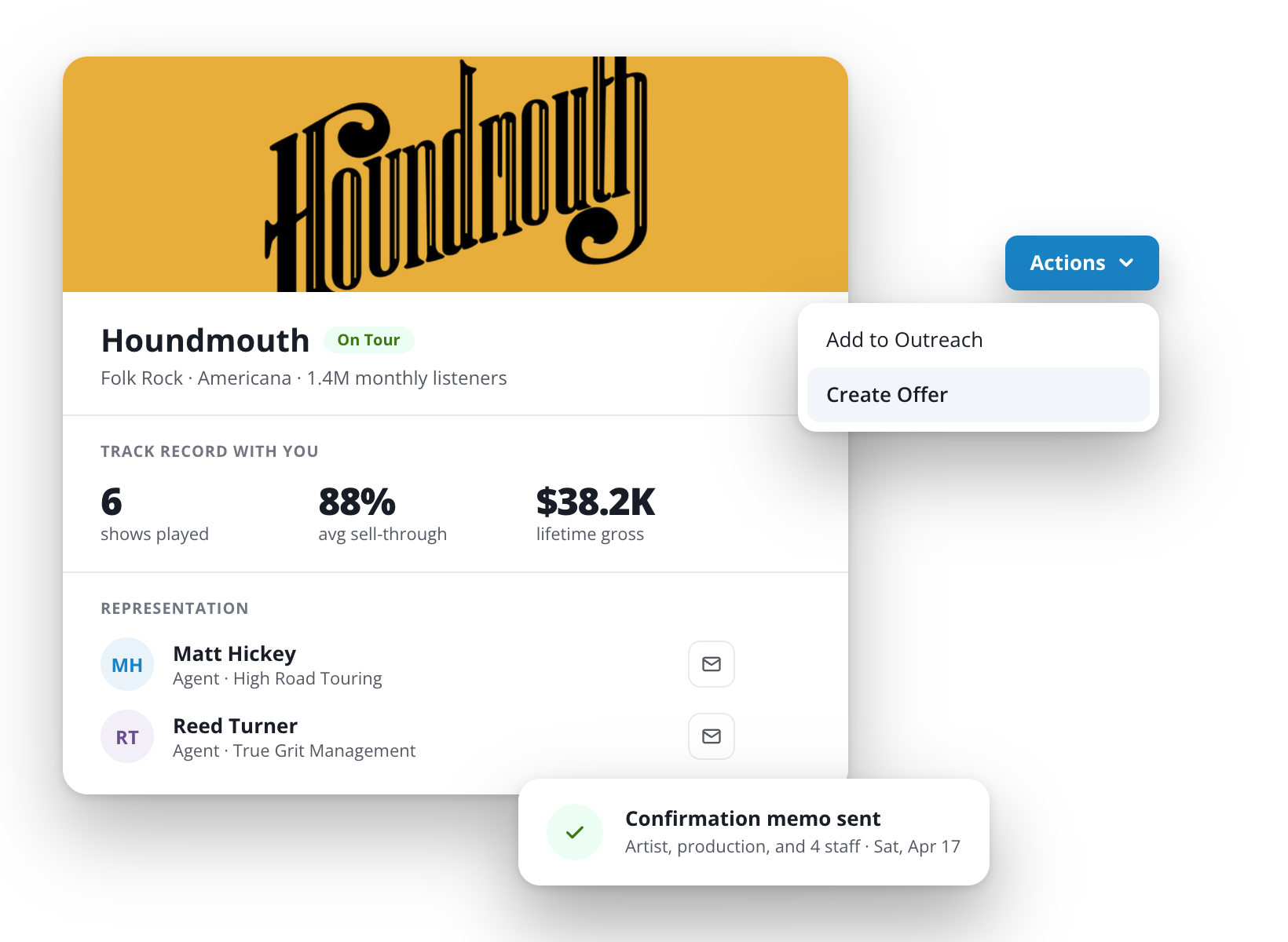

1,000+ shows a year with three talent buyers. 100+ confirmed a month. Offer velocity up 31%.
“Our challenge wasn't a lack of tools. It was too many of them.”
No. Tixr's published products are Platform, Fan Experience, Studio, Door, Reserved Seating and Integrations. A booking calendar, avails, artist offers, the advance and artist settlement don't appear on any of them. Their own integrations page names a separate booking platform for that work. On Opendate it sits on the record that sells the ticket.
It isn't, and the distinction is worth being precise about. Tixr's holds are seat and inventory holds: releasing seats, killing them, allocating comps for artists and production. A booking hold is a claim on a date before a show exists, ranked against other holds, promoting automatically when a higher hold drops. Opendate has both. Tixr publishes only the first.
Yes, and some rooms start there. Opendate's externally ticketed event type keeps your calendar and reporting whole while Tixr keeps selling. What you don't get until ticketing moves is the accepted offer building the on-sale and settlement running off live counts. Most rooms that start split don't stay split.
Tixr is stronger here and we'd rather say so. They publish 2D and 3D plans, best-available by price level, ADA colour-coding, and non-seat inventory like tables and cabanas. Opendate sells GA and reserved, and we build your charts in 3 to 5 days. If the seat map is the hardest problem in your building, weigh that seriously. If it's a handful of seated nights around a year of shows you book yourself, you'd be keeping a seat map and giving up the deal desk to do it.
Also theirs. Tixr's unified checkout covers tickets, merchandise, F&B, parking and hospitality in a single transaction, and that is a genuine advantage for a festival or a stadium. Opendate covers tickets, add-ons, memberships and payment plans. If total spend per fan across a multi-day site is the business, that gap matters more than anything on this page.
Tixr is credible on this and we don't dispute it: they market first-party data as ungated and exportable, with 90+ data points per buyer, and state they never sell or share it. The difference isn't ownership, it's what happens next. Tixr publishes no native email, SMS or push, so campaigns run through exports to partner tools. Opendate segments the same buyer and sends from the same login that booked the show.
Because the sync between them carries ticket counts, not the deal. The confirm still builds no on-sale, someone still rebuilds the show by hand, and the settlement still reconciles two systems. Tixr's own case study describes exactly this division of labour. Opendate removes the seam rather than automating across it.
Nothing on sale has to move. In-flight Tixr events sell through untouched, calendar import runs about a week, ticketing cuts over show by show, and seating charts take 3 to 5 days. Check your notice window before you start.
No. Tixr makes the data exportable, which makes this easier than most migrations. The list comes across with the calendar import and arrives as profiles you can segment, not a flat CSV.
Then Tixr is probably the right answer and you should take their call. They say they are built for big, their seat maps and unified cart are built for that scale, and Opendate isn't trying to serve a 10,000-cap amphitheatre. The case for Opendate starts in the room that books its own calendar, cuts its own offers and settles its own artists.