See how Opendate can help you manage the entire event lifecycle.
Let us know who you are to unlock the demo video.
Thank you! Your submission has been received!
Oops! Something went wrong while submitting the form.


















| Feature | Opendate | Spektrix |
|---|---|---|
| Programming calendar and date holds | ✓ Multi-venue calendar. Ranked holds that auto-promote, multi-date | ✕ Inventory holds on an existing event, not holds on a date |
| Artist offers and advance | ✓ Templates with splits, bonuses, comps, kills. Advance and run of show | ✕ Not included |
| Accepted offer builds the on-sale | ✓ Ticket types, prices, comps, kills, and announce dates build themselves | ✕ No offer stage, so every event is set up by hand |
| Artist settlement | ✓ One click, off the offer plus live counts | ✕ Not included |
| Show P&L | ✓ Forecast, actuals, tickets-to-breakeven before doors | ✕ Not included |
| Rental invoices and contracts | ✓ Rental bookings, invoices, and artist contracts on the event you sell | ✕ Venue operations handled through the partner directory |
| Checkout without a patron account | ✓ Embedded in your own site. No login, no account, no second website | ✕ Buyers are sent to a login page to sign in or create an account |
| Built-in email marketing | ✓ Email from the login that sold the seat, with segments that build themselves | ✓ Dotdigital bundled at no extra cost, with premade workflows. Parity |
| SMS and push | ✓ Both in the same subscription as the ticketing | ✕ No text channel in the platform. Runs through a third party |
| Patron CRM with journeys | ✓ Attendance, genre affinity, lifetime spend, and giving on one record | ✓ One CRM across ticketing, marketing, and fundraising. Parity |
| Ticketing and reserved seating | ✓ GA and reserved. Fully customizable seat maps you edit yourself | ✓ Assigned, general admission, and timed entry. Reserved plans built for you |
| Season subscriptions and memberships | ✓ Flex packs, season subscriptions, memberships, payment plans | ✓ Subscriptions, memberships, offers, and incentives. Parity |
| Donor management and giving | ✓ Donations, funds, pledges, and planned giving, with outreach automations | ✓ Campaigns, funds, pledges, recurring giving, and stewardship. Parity |
| High-demand on-sales | ✓ Per-card caps, max per fan, reCAPTCHA, 2FA | ✓ Built-in queuing and automated release waves. Stronger |



Opendate sends the offer and the contract, and the moment the artist accepts, the event is already configured. Ticket types, prices, comps, kills, and announce dates come straight off the deal, so nobody retypes the show out of a booking tool or an email thread, and the box office checks an event rather than building one. Spektrix starts once the event exists, so someone sets it up by hand first.
Advance templates go out from the show page, and guest lists, tech details, and day-of notes come back to it, so production, the box office, and the artist work from one version. Spektrix has no advance or run of show, so that coordination happens outside the system selling the ticket.
Splits, bonuses, and comps calculate against live door counts, off the offer you already agreed, and forecast against tickets-to-breakeven sits beside it before you confirm. Spektrix reports on sales in real depth, but the artist's number and the event's cost aren't part of it.
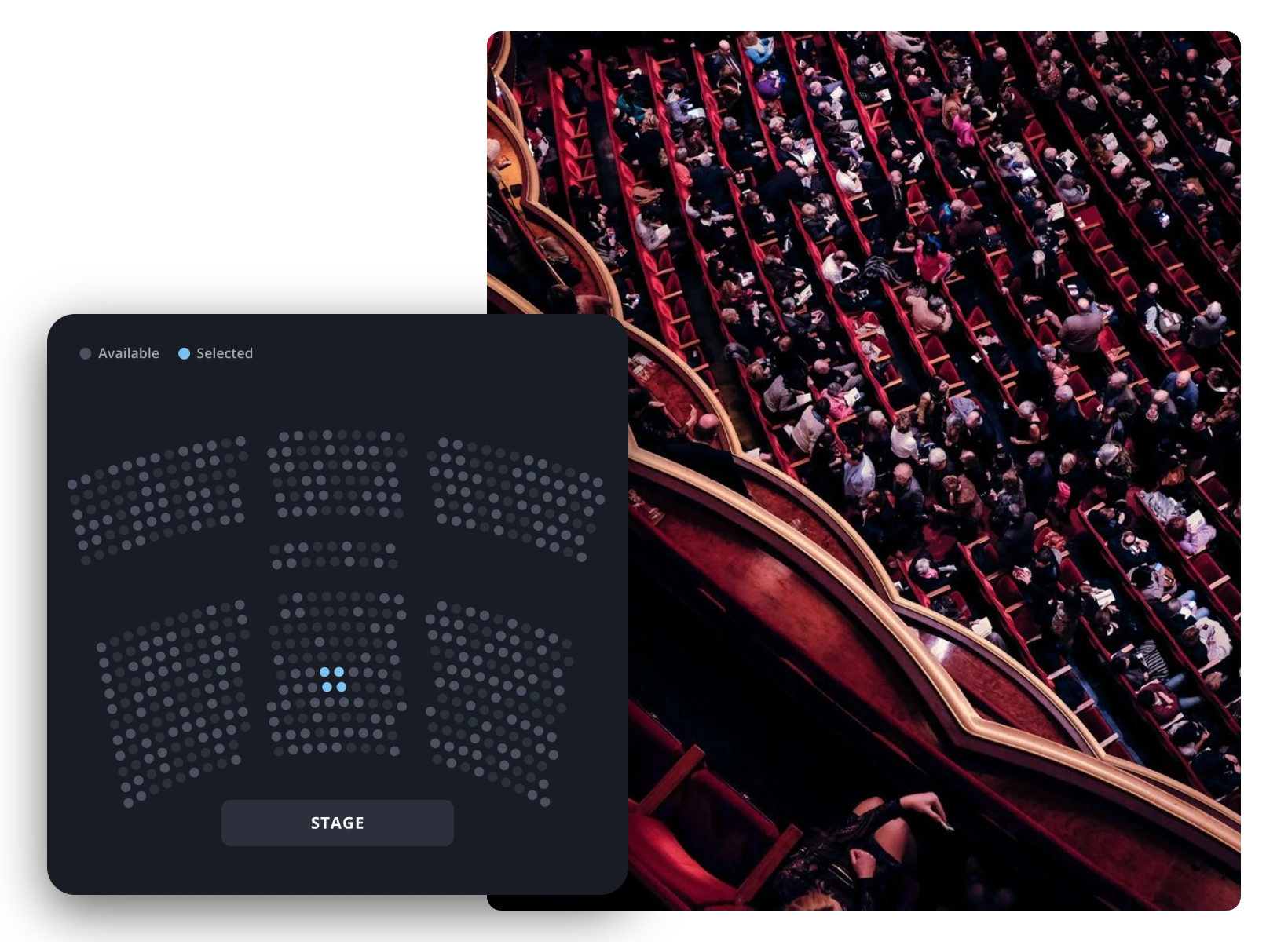
Your own team builds and reconfigures the room without filing a request. On Spektrix you can create simple unreserved plans yourself, and everything else is built for you on request. Seats can't be added to an existing plan without asking for a new one.
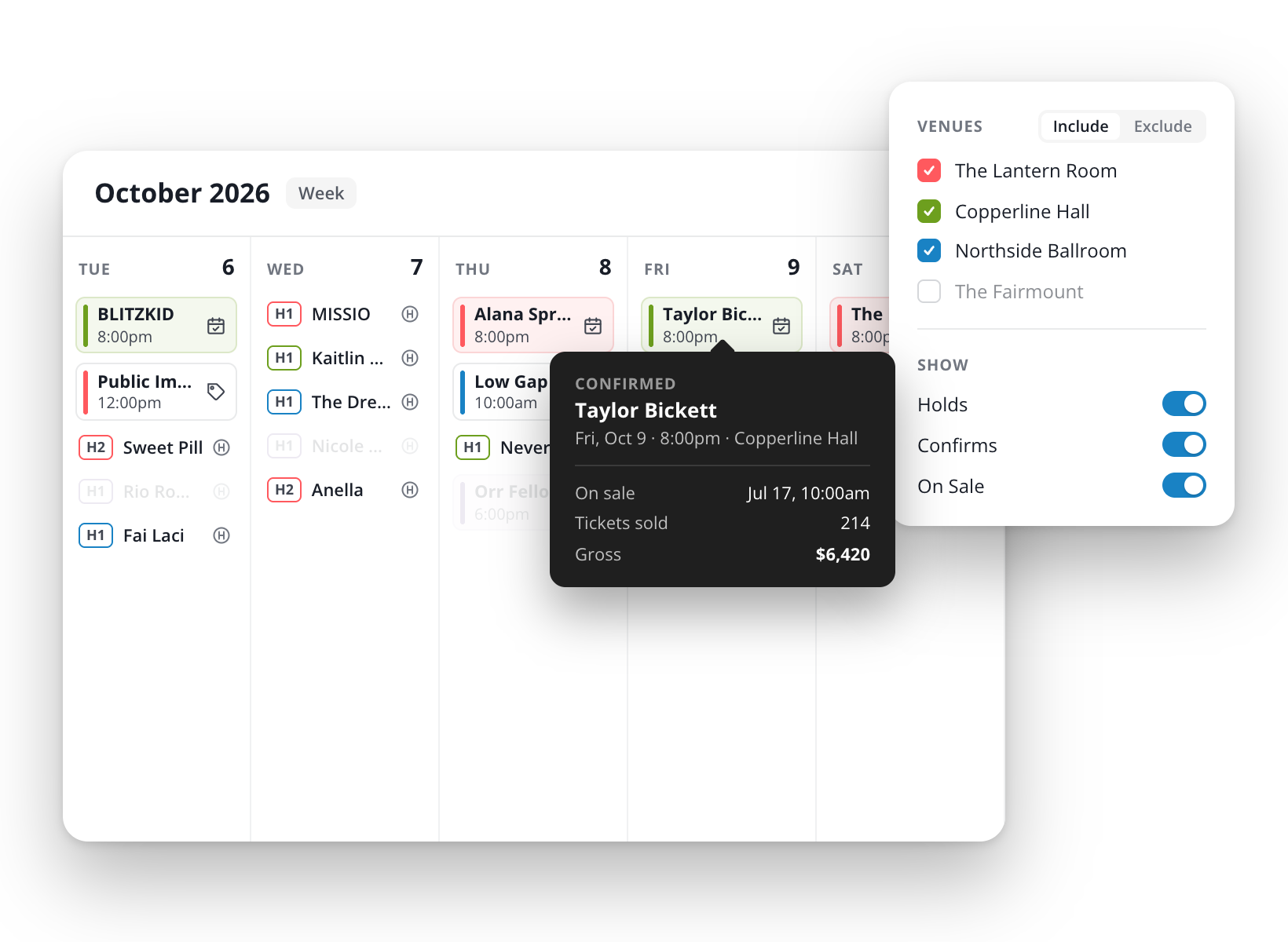
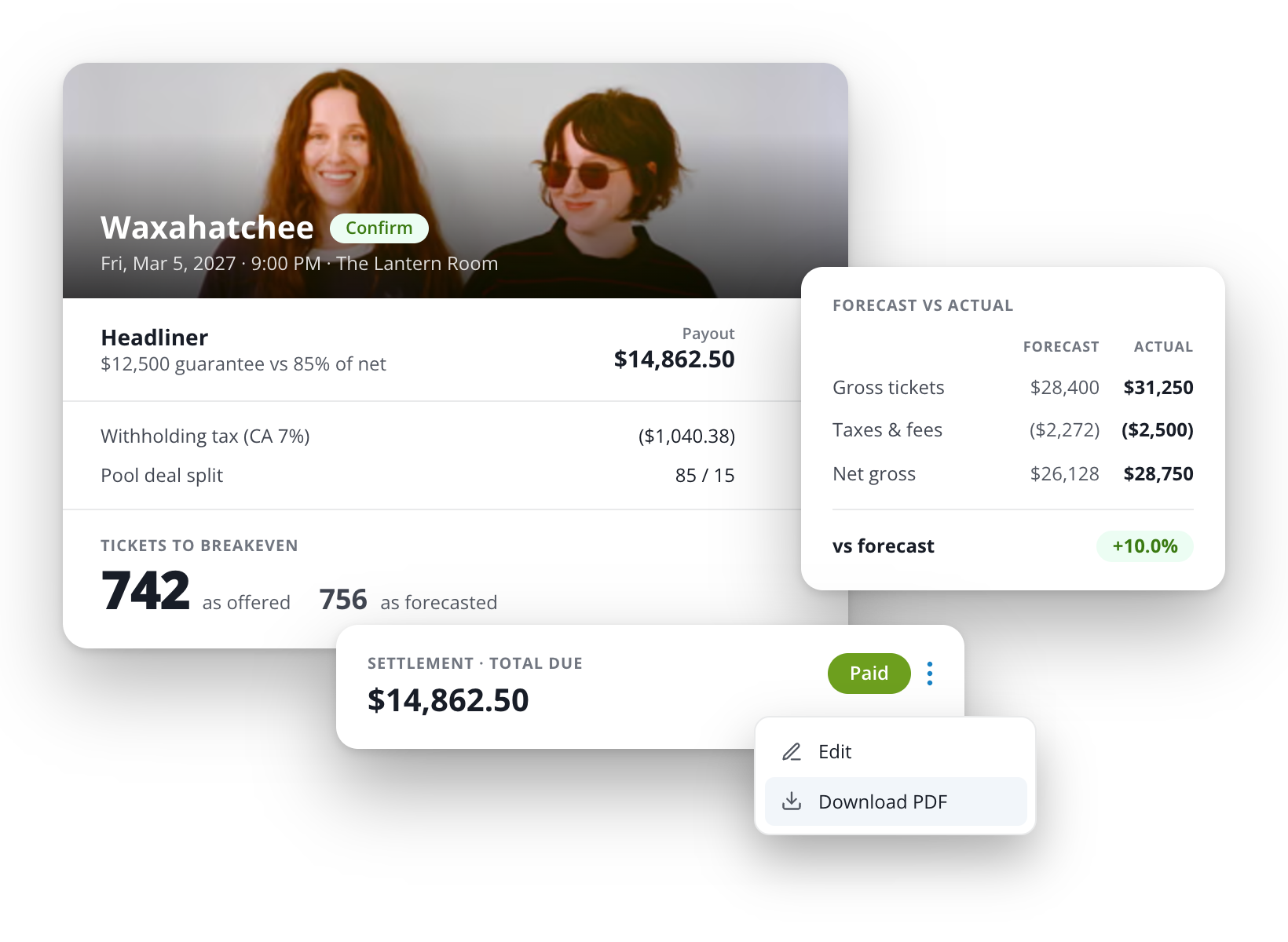


180+ events, 38,000+ tickets, 2026 pipeline up 82% year over year. Revenue grew every quarter, with Q4 60% above Q2.
“What initially drew me to Opendate was the single, integrated platform for our team to create offers, book, ticket, promote, settle, and report on finances within a single intuitive system.”
Not the part before the event exists. Spektrix is four connected areas, ticketing, CRM, marketing, and fundraising, and all four start once there is an event to sell. A programming calendar, avails, ranked holds on a date, artist offers, and the advance aren't in it. On Opendate that work sits on the record that will sell the seat, weeks before the on-sale.
No, and the distinction matters. Theirs are inventory holds: seating plan overlays that take seats off sale, hold back allocations, or assign price bands on an event that already exists. A booking hold is a claim on a date before there is an event, ranked against competing holds and promoting automatically when a higher one drops. Opendate has both.
The event builds itself. Opendate sends the offer and the contract for you, and the moment it comes back accepted, the on-sale is already configured: ticket types, prices, comps, kills, and announce dates come straight off the deal you agreed. Nobody retypes the show out of a booking tool or an email thread into the ticketing system, which is where the wrong on-sale time and the missing comp usually come from. For a box office it's the difference between building every event by hand and checking one that's already built.
Better than most, and worth saying so. Dotdigital email comes bundled at no extra cost, with premade workflows for pre-event and post-event sends, membership reminders, re-engagement, segmentation off live CRM data, and more than forty premade reports. That is a real advantage and we're not going to pretend otherwise. What's missing is SMS: there's no text channel in the platform, so that half of an announce sequence runs through a third party. Opendate carries email, SMS, and push in the same subscription as the ticketing.
This is the difference worth checking before you buy either one. On Spektrix you can create simple unreserved seating plans yourself, and everything else is built for you on request through a seating plan form. Seats can't be added to an existing plan without requesting a new one, and seat labels, orientation, and maximum capacity are fixed once a plan exists. On Opendate the charts are yours: your team reconfigures the room the week you decide to, without filing a request.
Close to it. Spektrix covers donation campaigns tied to funds, pledges and long-term commitments, recurring giving with tiered benefits, stewardship activity, and tracking of calls, emails, and meetings against the donor. Opendate carries donations, funds, pledges, planned giving, and donor records on the same patron record as attendance and ticket spend, with outreach automations that build their own segments. Compare them against your own giving program rather than against this page.
Not on Opendate. The checkout embeds in your own pages, so a buyer gets a ticket without a login, without an account they'll never use again, and without being handed off to a second website to pay. On Spektrix, a buyer who isn't signed in is sent to a login page to sign in or create an account before they can check out, and every abandoned cart there is a ticket you didn't sell.
Spektrix is stronger here. They have built-in queuing and automated release waves for the nights everyone refreshes at once. Opendate has per-card caps, max-per-fan limits, reCAPTCHA, and 2FA, which suit a room selling hundreds to a few thousand. If your hardest night is a season launch that melts the server, weigh that seriously.
Spektrix points venue operations at its partner directory rather than handling it in the platform, alongside categories like volunteer management and classes. That is a reasonable way to build a product, and it does mean another vendor, another login, and another invoice for the dark-night side of the building. On Opendate the rental booking, the invoice, and the artist contract sit on the same event the box office is selling.
Spektrix is quoted per client: no upfront software costs, and nothing charged until you start selling tickets, with onboarding, support, and updates included. Ask for the full schedule including payment processing before you compare anything. Opendate's tiers are public: Opener free, Marquee from $4K a year, and Headliner free with ticketing. All-In Pricing shows the patron the total before checkout.
Nothing on sale has to move. In-flight events sell through untouched, and the externally ticketed event type keeps the season's calendar and reporting whole through one overlapping on-sale cycle. Calendar import runs about a week, ticketing cuts over event by event, and your seat maps are yours to build and adjust as you go.
Then a good deal of Opendate is overhead you won't use, and we'd rather say so. If the building is rented, the promoter brings the show, and your job is selling the seat and scanning it at the door, Spektrix covers that and covers it well. The case for Opendate starts when the dates, the offers, the advances, and the settlements become your problem.