See how Opendate can help you manage the entire event lifecycle.
Let us know who you are to unlock the demo video.
Thank you! Your submission has been received!
Oops! Something went wrong while submitting the form.










| Feature | Opendate | Tessitura |
|---|---|---|
| Booking calendar, avails | ✓ Multi-venue calendar. Avails you can paste to an agent | ✕ Not included |
| Date holds | ✓ Ranked holds that auto-promote, multi-date | ✕ Not published in either sense |
| Artist offers | ✓ Templates with splits, bonuses, comps, kills | ✕ Not included |
| Advance and run of show | ✓ Advance templates, guest lists, day-of detail | ✕ Not included |
| Artist settlement | ✓ One click, off the offer plus live counts | ✕ Not included |
| Show P&L | ✓ Forecast, actuals, tickets-to-breakeven before doors | ✕ Revenue dashboards and reporting. No event-level cost or breakeven |
| Ticketing, reserved seating | ✓ GA and reserved. Charts built in 3–5 days | ✓ Core product. Unlimited seat maps, best-available. A real strength |
| Subscriptions, season packages | ✓ Memberships, tiers, early access, payment plans | ✓ Full-season, voucher and choose-your-own packages. Deeper |
| Fundraising | ✓ Donations, funds and donor records | ✓ Pledges, matching gifts, moves management. Unmatched |
| Fan CRM and owned channels | ✓ Genre, spend, automated segments. Email, SMS, push built in | ✓ Deep patron CRM with journeys. Email deployed through partners |



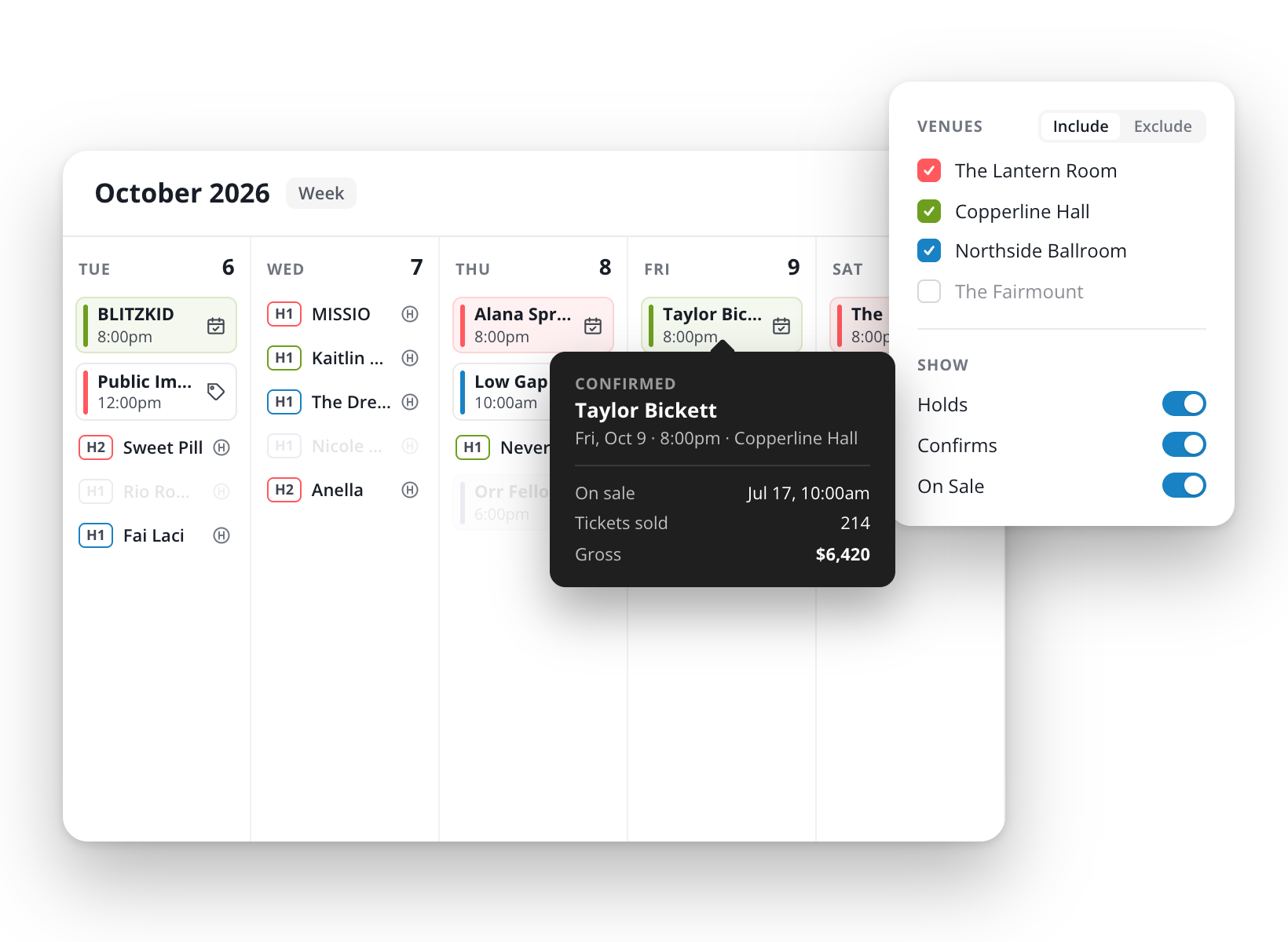
Avails, ranked holds and the artist offer live on the record that sells the ticket, so the deal you sign carries its ticket types, comps, kills and announce dates into the on-sale. Tessitura publishes twelve modules and a hold isn't among them, in either the seat sense or the date sense, so the Tuesday hold lives in a spreadsheet beside the box office.
Advance templates go out from the show page, and guest lists, tech details and day-of notes come back to it, so production, the box office and the artist work from one version. Tessitura publishes no advance or run of show, so that coordination happens outside the system selling the seat.
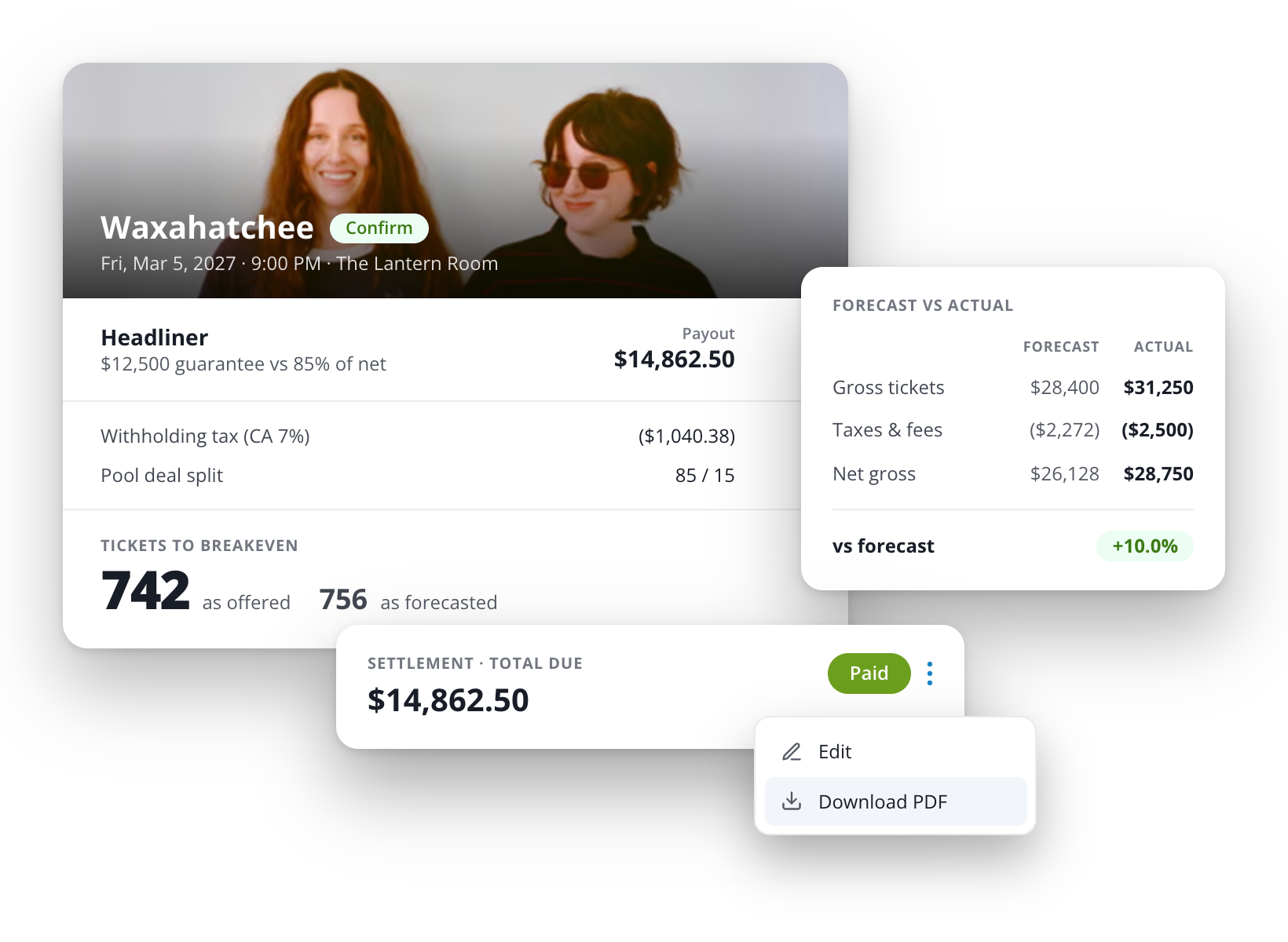
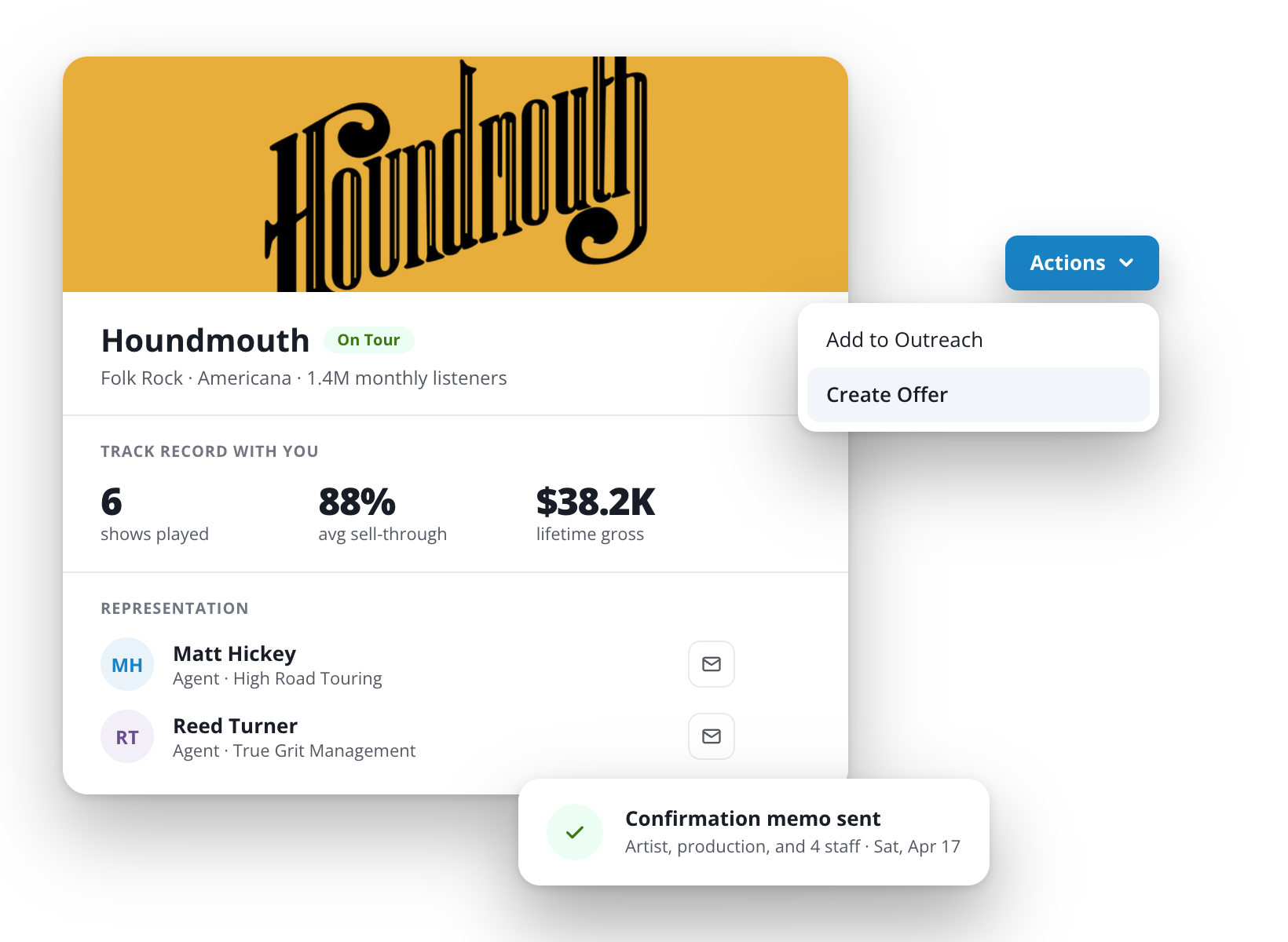
Splits, bonuses and comps calculate against real sales, from the same record that holds the offer you agreed to, so the artist signs before load-out. At 20 Front Street, work that used to take over an hour now takes minutes.
Forecast, actuals and tickets-to-breakeven sit on the show page next to the offer. You price the guarantee against the room instead of finding out when the settlement sheet comes back.


180+ events, 38,000+ tickets, 2026 pipeline up 82% year over year.
“What initially drew me to Opendate was the single, integrated platform for our team to create offers, book, ticket, promote, settle, and report on finances within a single intuitive system.”
No. Tessitura publishes twelve modules: CRM, Ticketing and Admissions, Fundraising, Memberships, Marketing, Business Insights, Access Control, Mobile and E-commerce, Education and Groups, Retail, Payment Processing and Hosting. A booking calendar, avails, artist offers, the advance and artist settlement appear in none of them. On Opendate all of it sits on the record that sells the seat.
Not that they publish, in either sense. The word doesn't appear on their ticketing pages, for seats or for dates. The nearest published concepts are member and VIP presales and the scheduled release of unrenewed seats, which is inventory management. A ranked date hold that promotes when a higher hold drops is a different thing, and it's the thing a talent buyer uses every week.
No, and we'd rather say so plainly. Opendate has donations, funds and donor records. It has no pledges, matching gifts, planned giving, grant tracking or moves management, and Tessitura's development depth is unmatched. If fundraising is the business, keep Tessitura and weigh Opendate for the booking side.
Also theirs. Full-season, voucher-based and choose-your-own packages, renewable seated subscriptions where patrons keep their seats, suggested contributions in renewal notices. Opendate has memberships with tiers, early access and payment plans, not that depth. If nine months of the year is a season sold in advance, that matters more than anything else on this page. If the season sits around 150 one-off nights you book yourself, the deal desk is the bigger gap.
They don't state it as a requirement, and we won't claim they do. What they publish is a super-user model, where someone on your team develops specialist expertise and drives adoption, plus retainer consulting that works alongside your staff day to day, and a large structured training library. Draw your own conclusion about the operating cost. Opendate is built to be run by the box office staff you already have.
Worth clearing up, because the word means two things. Tessitura is a not-for-profit that says it answers directly to its user base, with user groups and an annual conference. Separately, Consortium is a product: several organisations sharing one database while keeping their own branding, policies and ledger. If a shared database across partner organisations is what you need, that's a real capability and Opendate has no equivalent.
You do, on both. Tessitura's patron record is deep and genuinely good, spanning visitors, members, donors and volunteers with relationship mapping. The difference is what the record is attached to: on Opendate it sits beside the offer that booked the night, so the announce goes out off the confirm rather than off an extraction.
Tessitura is negotiated per institution, so ask for the full picture including implementation, training and ongoing consulting before you compare anything. Opendate publishes its tiers: Opener free, Marquee from $4K a year, and Headliner free with ticketing.
Yes, and for a Tessitura house that's usually the sensible path. Keep fundraising and the subscription season where they are. Calendar import is same-week, offer templates take about half a day, and ticketing can cut over show by show for the one-off programme while the season stays put.
Then Tessitura is probably right and this page isn't for you. Their fundraising depth, patron CRM and season tooling are built for exactly that, and Opendate isn't trying to replace them. The case for Opendate starts when the programme is one-off shows with guarantees, splits and settlements, and when the hold still lives on a whiteboard.