See how Opendate can help you manage the entire event lifecycle.
Let us know who you are to unlock the demo video.
Thank you! Your submission has been received!
Oops! Something went wrong while submitting the form.


Running a live music venue today is not just about booking great shows. It is about managing rising costs, tighter margins, heavier workloads, and higher expectations across every part of the operation. For many operators, the challenge is not effort or experience. It is visibility. Without clear data, it is hard to know what success looks like, what needs attention, and how your venue compares to others navigating the same pressures.
That is exactly why Opendate created the Live Entertainment Benchmarking Report.
The report is built from real venue data and designed to answer the questions operators ask quietly but rarely get clear answers to. How many shows are similar venues booking? Where is revenue actually being generated? How consistent are marketing efforts across top-performing teams? And what operational patterns show up again and again at venues that are outperforming their peers?
One of the clearest takeaways from the benchmarking data is that higher-performing venues tend to operate similarly, even if they differ in size, market, or genre focus. Performance is less about one big advantage and more about consistent execution across a few key areas.
For exaple, the data shows meaningful differences in show volume and pacing. Top-performing venues tend to maintain steadier booking calendars, avoiding long gaps between shows and reducing reliance on last-minute additions. This consistency not only impacts revenue, but also affects marketing rhythm, staffing efficiency, and audience engagement.
Revenue performance tells a similar story. While ticket prices between average-performing and top-performing venues vary only slightly, higher-performing venues tend to generate more revenue per ticket overall trhough add-ons and ancillary revenue. This is not just about price. It reflects better coordination between booking, marketing, and promotion, as well as stronger visibility into how shows are performing before doors open.
Marketing consistency is another area where the benchmarks stand out. Top venues are not necessarily doing more marketing. They are doing it more reliably. Campaigns launch earlier, promotion is more evenly distributed across channels, and fewer shows are left to chance. Over time, this compounds into stronger attendance and more predictable outcomes.
Another theme that shows up clearly in the data is the impact of operational clarity. Venues that perform well tend to have fewer handoffs, less duplicated work, and better alignment between teams. Booking, marketing, and operations are working from the same information rather than separate spreadsheets, inboxes, or systems.
This matters because inefficiency carries a real cost. Missed deadlines, unclear ownership, and last-minute scrambles all chip away at margin and morale. The benchmarking data suggests that venues with stronger internal visibility are better positioned to scale their calendars, manage growth, and adapt when things change.
This is where many operators feel the pressure most acutely. As calendars get fuller and teams stay lean, the cost of disorganization increases. The data reinforces that better systems and shared visibility are no longer “nice to have.” They are foundational to performance.
Benchmarks are only useful if they lead to better decisions. That is why the Live Entertainment Benchmarking Report is structured to be practical, not academic. Each section is designed to help operators identify where they may be overperforming, underperforming, or operating without enough insight.
Used well, the data becomes a tool for prioritization. It helps answer questions like: Where should we focus first? Are we under-marketing shows relative to peers? Are we leaving revenue on the table? Are our internal processes holding us back?
In this edition, we walk through major sections of the report and highlight patterns that consistently show up among higher-performing venues. More importantly, we will hear directly from venue operators about how they are applying these insights day to day.
The panel will include Jason Williams of The Castle Theatre, Rachel Hunt of Grog Shop, and additional venue leaders, moderated by Opendate's Jonathan Gandolf. Together, they will discuss how data is influencing booking decisions, improving marketing execution, and creating smoother internal operations.
This is not a theoretical discussion. It is a candid look at how operators are using better visibility and better benchmarks to run more profitable, more sustainable venues.
If you have not yet downloaded the Live Entertainment Benchmarking Report, that is the best place to begin. The report provides context for the webinar and offers immediate takeaways you can apply to your own venue.
👉 Download the Live Entertainment Benchmarking Report
Whether you are validating what you are already doing or looking for new ways to improve performance, the data offers a clear starting point. And the conversation does not stop with the report. We look forward to continuing it live.
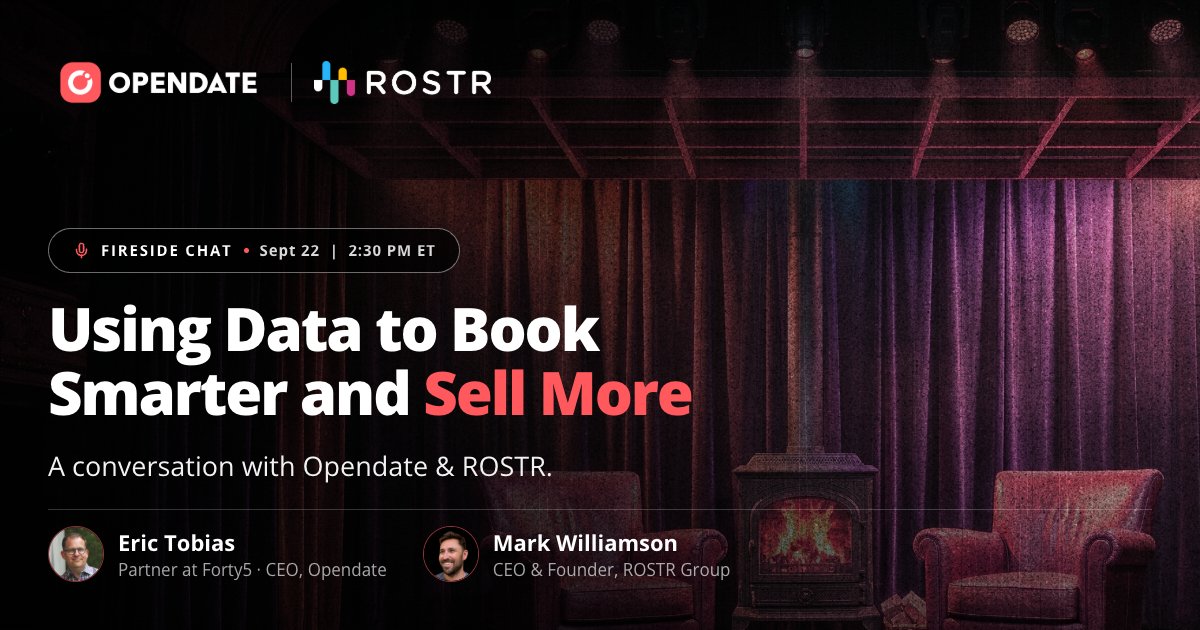
A fireside chat with Opendate & ROSTR: why the agent knows an artist is breaking before the venue does, and how to get your offer in while the routing is still open.
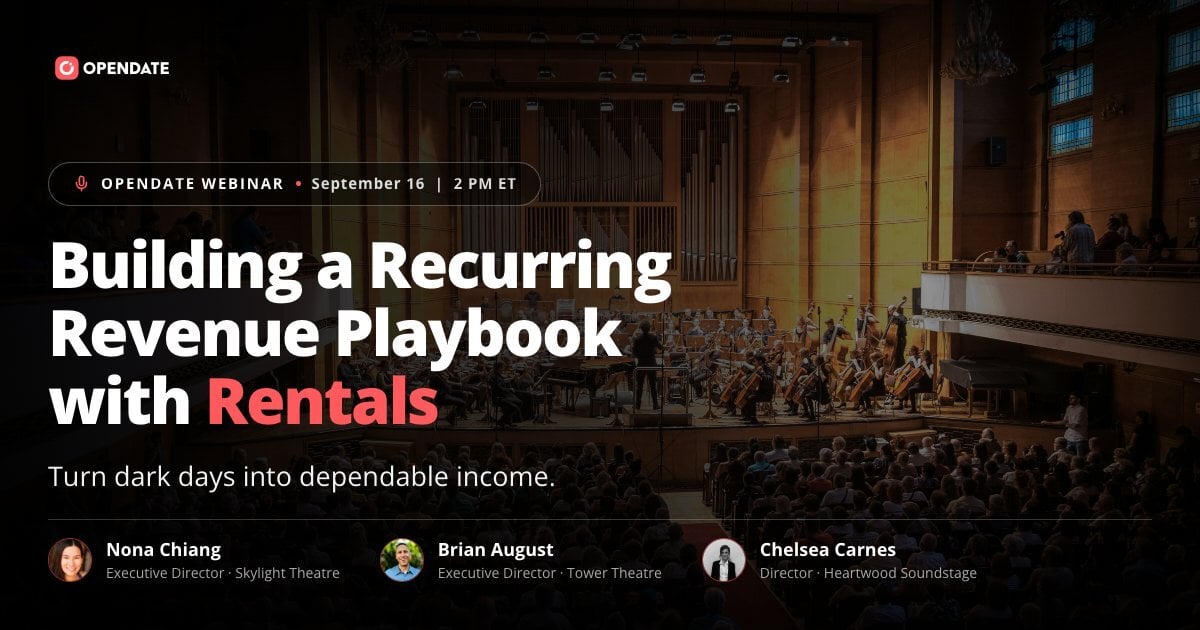
Weddings, corporate events, a reading, a local orchestra, a touring show between stops — revenue that doesn't depend on how your season is selling.