See how Opendate can help you manage the entire event lifecycle.
Let us know who you are to unlock the demo video.
Thank you! Your submission has been received!
Oops! Something went wrong while submitting the form.


Ask any venue marketer how they measure the ROI of a show's ad campaign and you'll get a version of the same answer.
"I pull the spend from Ads Manager. I pull the ticket numbers from our ticketing system. I drop both into a spreadsheet. I match them by hand. It takes an hour. Usually I do it on Sunday night."
This is not a complaint about any one tool. It's a description of how the job is done at almost every independent venue in the country. And it has real costs — most of them invisible until you add them up.
When your ad data and your ticket data live in separate systems, three things happen.
First, decisions get made too late. A campaign that's quietly underperforming doesn't show up in a spreadsheet until after the show has already sold through, or worse, under-sold. By the time you can see the pattern, the money is already spent.
Second, good work stops being provable. Marketers know — by instinct, by experience — when a campaign is moving tickets. But knowing isn't the same as proving. When budget conversations happen with owners or GMs, instinct doesn't hold up. "I think the ads worked" loses every time to "the spreadsheet says we spent $4,200."
Third, the lessons don't compound. Every show is reconciled in isolation. The patterns that would tell you which artists respond to paid social, which genres need more runway, which venue-artist combinations over-perform their ad spend — that institutional knowledge never gets built, because the data to build it is scattered across screenshots and spreadsheets that nobody ever looks at twice.
The separation wasn't designed. It was inherited.
Ad platforms were built for advertisers. Ticketing platforms were built for ticket sellers. Neither was built for the operator who has to do both. Most ticketing companies decided early on that marketing wasn't their problem — it was a partner integration, at best, or a separate product line at worst. So the data never found its way home.
That's fine if you're running a Fortune 500 arena with a dedicated business intelligence team and a six-figure attribution tool. It's not fine if you're running a 600-cap club with a marketing team of one-and-a-half.
Independent venues, attractions, and performing arts centers don't need more tools. They need fewer tools that talk to each other.
We spend a lot of time at Opendate thinking about what it means to run a business well. The thesis we keep coming back to is simple: booking, ticketing, and marketing are three parts of the same job, and they should live in the same place.
When booking decisions reference ticket sales history, talent buyers make smarter offers.
When ticketing data flows into marketing automations, campaigns target fans who actually buy.
And when ad spend lives on the same event record as ticket revenue, marketers can finally answer the question they've always been asked and never had a good answer for: "what did the ads do?"
Not in a spreadsheet. Not in a screenshot. On the event. In real time. Next to the artist contract and the ticket count.
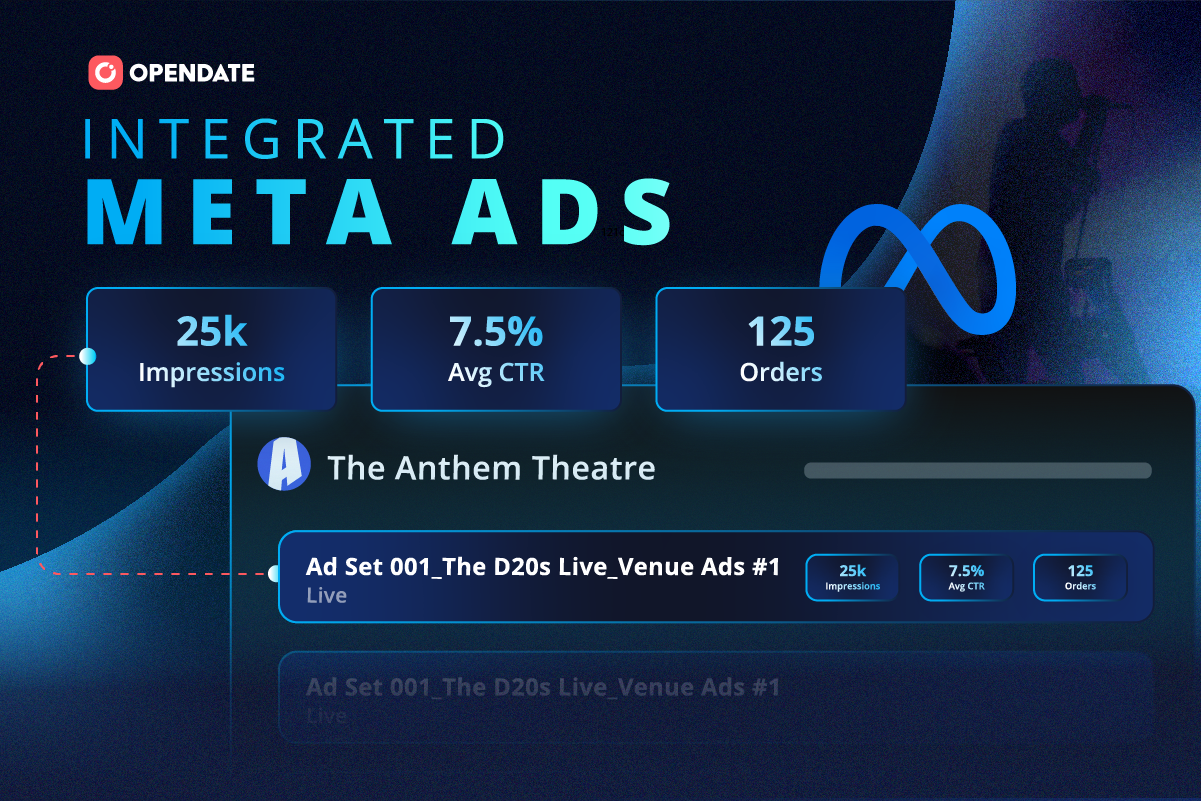
Opendate's Meta Ads integration closes the last open gap on that thesis. Spend, impressions, clicks, and reach now flow directly into every event in Opendate, auto-matched to the show, updated daily.
We're not the first ticketing platform to say marketing matters. We think we're the only one treating it like a first-class part of the product — built in, not bolted on.
If you're a marketer at an independent venue and you've lost a Sunday night to Ads Manager, you can connect your account today and get that time back.
And if you're an owner, a GM, or a talent buyer at one of the roughly 200 venues already running on Opendate — the next time someone asks what the ads did for your biggest show of the quarter, the answer is two clicks away.

