See how Opendate can help you manage the entire event lifecycle.
Let us know who you are to unlock the demo video.
Thank you! Your submission has been received!
Oops! Something went wrong while submitting the form.







| Feature | Opendate | EVENTIM |
|---|---|---|
| Booking calendar, avails | ✓ Multi-venue calendar. Avails you can paste to an agent | ✕ Not included. Documented through a booking partner |
| Date holds | ✓ Ranked holds that auto-promote, multi-date | ✕ GA ticket holds for artist, media and marketing. Not date holds |
| Artist offers | ✓ Templates with splits, bonuses, comps, kills | ✕ Not included |
| Advance and run of show | ✓ Advance templates, guest lists, day-of detail | ✕ Not included |
| Artist settlement | ✓ One click, off the offer plus live counts | ✕ A ticket-sales summary report. Fees, costs and splits not included |
| Show P&L | ✓ Forecast, actuals, tickets-to-breakeven before doors | ✕ Not included. Net profit documented through a booking partner |
| Annual volume ceiling | ✓ None. Volume never changes your tier | ✕ Self-service: 6,000 per event, 12,000 per year, then sales |
| Reserved seating | ✓ GA and reserved. Charts built in 3–5 days | ✕ Excluded from self-service |
| Branded pages, payment plans | ✓ Event pages, embeds, memberships and payment plans | ✕ Both excluded from self-service |
| Fan CRM and owned channels | ✓ Genre, spend, automated segments. Email, SMS, push built in | ✕ Exportable reports. Email and SMS through a partner integration |

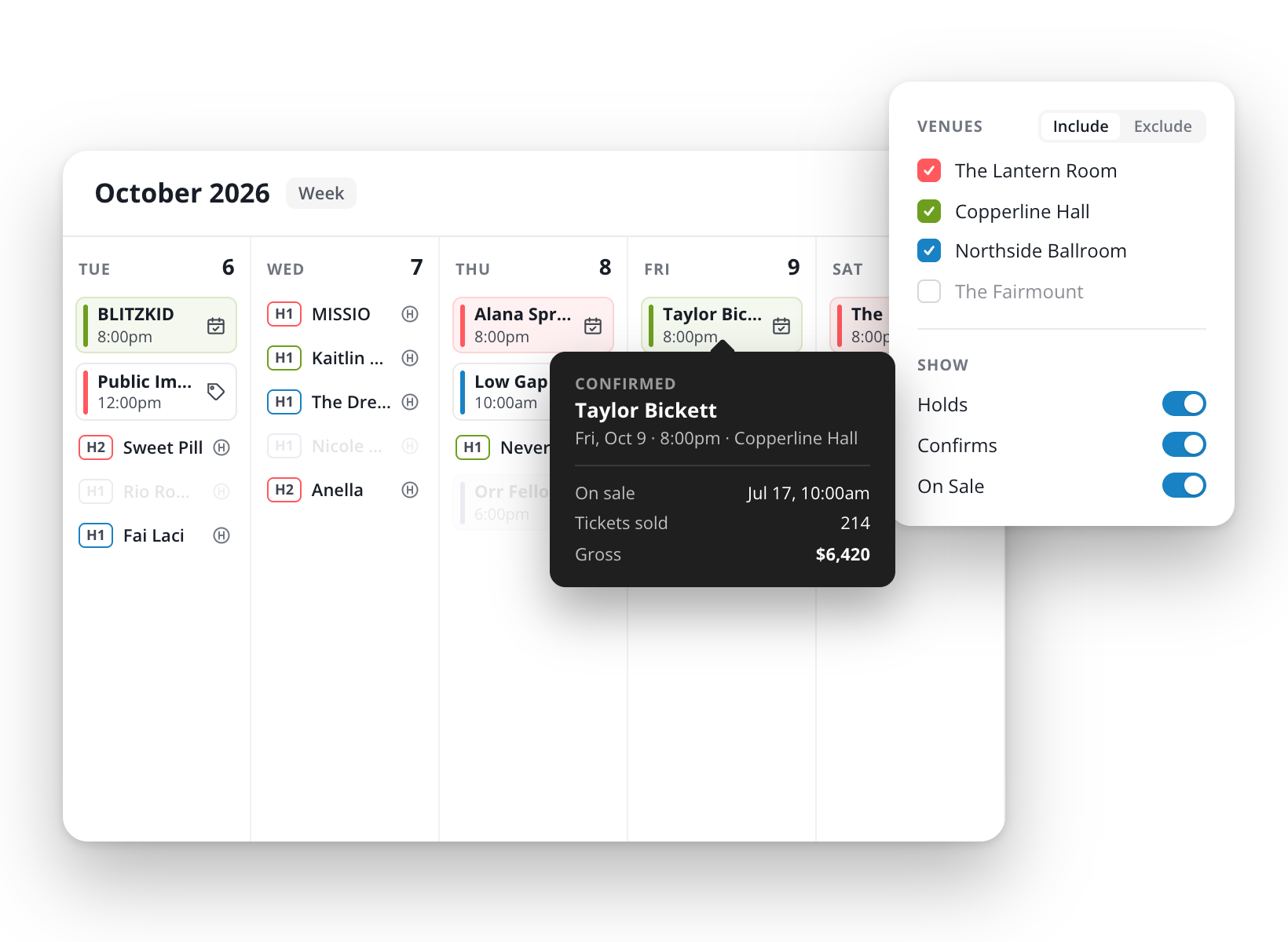
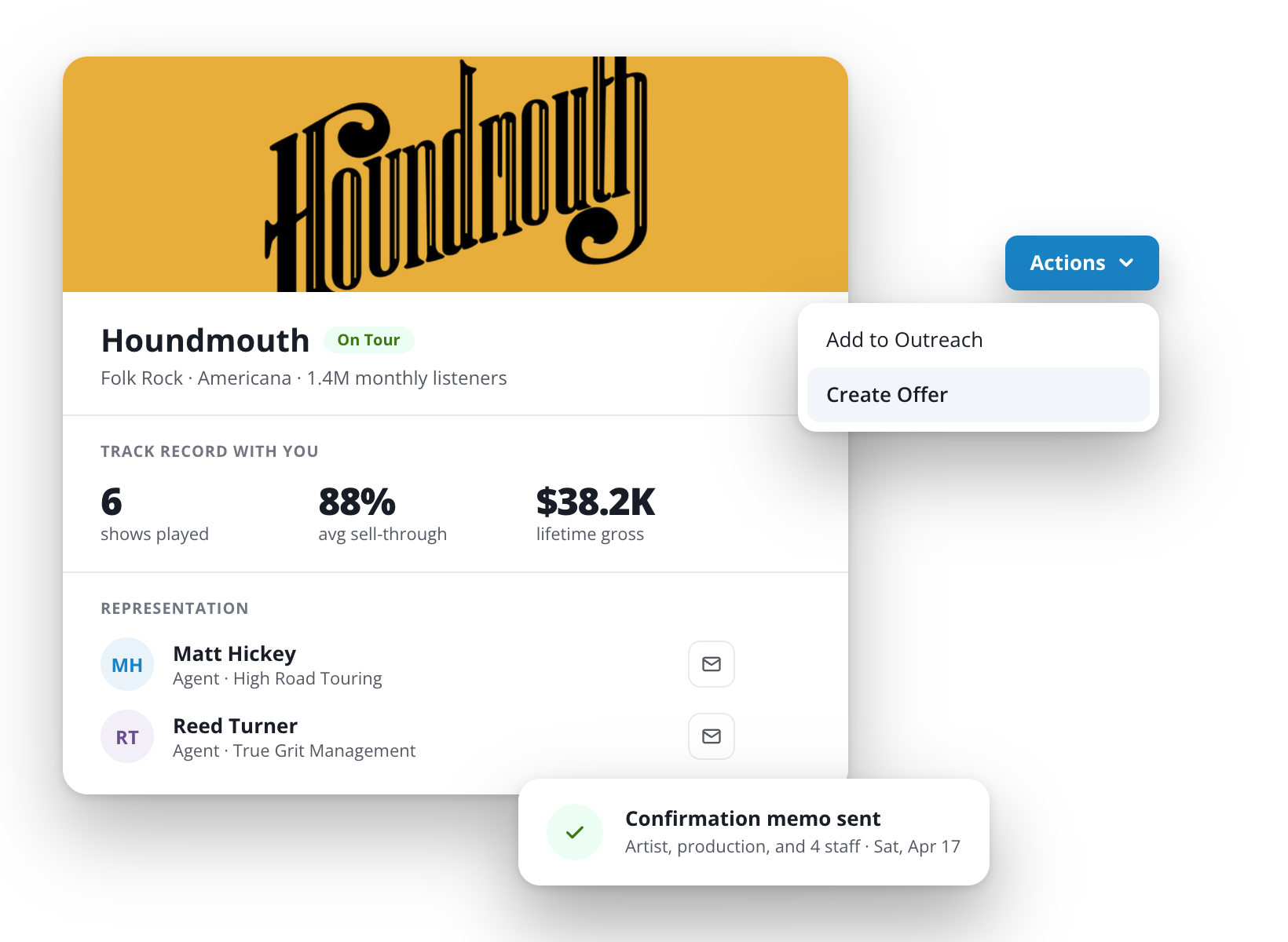
Avails, ranked holds and the artist offer live on the record that sells the ticket, so the deal you sign carries its ticket types, comps, kills and announce dates into the on-sale. EVENTIM has GA holds, but they hold tickets for artists, media and marketing rather than holding a date, and no booking calendar sits behind them.
Advance templates go out from the show page, and guest lists, tech details and day-of notes come back to it, so production, the box office and the artist work from one version. EVENTIM publishes no advance or run of show, so that coordination happens outside the system selling the ticket.
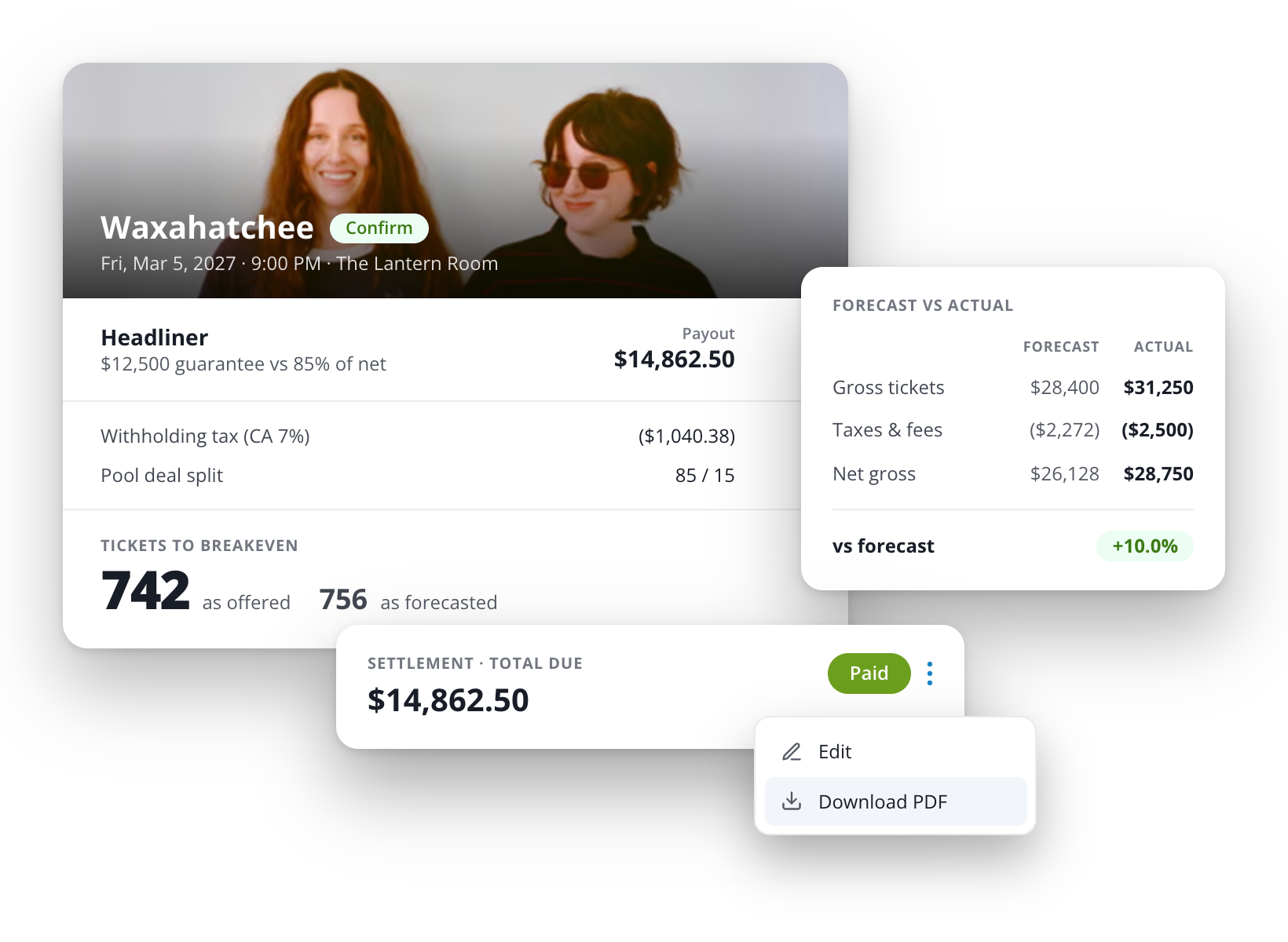
Splits, bonuses and comps calculate against real sales, from the same record that holds the offer you agreed to, so the artist signs before load-out. At 20 Front Street, work that used to take over an hour now takes minutes.
Forecast, actuals and tickets-to-breakeven sit on the show page next to the offer. You price the guarantee against the room instead of finding out when the settlement sheet comes back.


First year on Opendate: 180+ events, 38,000+ tickets, pipeline up 82% year over year.
“The ability to automate presales and onsales across every type of event has been a game-changer. What used to take manual coordination now happens seamlessly.”
No. The published product covers event setup, custom URLs, discount codes, link tracking, reporting and a daily stats email. A booking calendar, avails, artist offers and the advance appear nowhere in it. Their own help centre documents connecting to a separate booking platform for that work, and for show-level net profit. On Opendate all of it sits on the record that sells the ticket.
Their help centre is direct about it: if you expect to sell more than 6,000 paid tickets for a single event, or run multiple events totalling more than 12,000 tickets a year, you're asked to contact them. A 400-cap room running four nights a week crosses that inside a year. On Opendate volume never changes your tier.
No, and the difference matters. GA Holds set aside blocks of tickets so they aren't sold publicly, for artist, media and marketing use, then get comped or released. A booking hold is a claim on a date before the show exists, ranked against competing holds and promoting when a higher one drops. Opendate has both. EVENTIM publishes only the first.
It's a ticket-sales summary, and worth understanding precisely before you compare. It shows sold and unsold tickets and face-value sales, and their own documentation notes fees are not included on it. There are no expenses, no guarantee, no splits and no bonuses, so it's a useful number to hand a tour manager rather than a settlement. Opendate runs the splits, bonuses and comps against live door counts off the offer you signed, and the artist signs before load-out.
Not on self-service. Their help centre lists reserved seating, customer payment plans, branded ticketing pages and a dedicated account manager as the things self-service leaves out. They do have a full-service tier, so ask what moving to it involves and what it changes. Opendate runs seated and GA rooms on one tier, with charts built in 3 to 5 days and payment plans included.
You can get it. Order-level customer data comes out through their reports, which is a fair position and better than some. What isn't there is a CRM: email and SMS run through a separate marketing integration, so the record lives in one system and the campaign in another. Opendate writes the profile at the point of sale with genre affinity and lifetime spend, and sends from the same login.
Yes. See Tickets US became Eventim following CTS Eventim's acquisition, with the name change in February 2025 and the domain moving to eventim.us that July. Old links redirect. If you're comparing notes from 2024, you're comparing the same product.
EVENTIM quotes per client and doesn't publish rates, so ask for the full schedule including payment processing before you compare anything. Opendate publishes its tiers: Opener free, Marquee from $4K a year, and Headliner free with ticketing. All-In Pricing shows the fan the total before checkout.
Nothing on sale has to move. In-flight events sell through untouched, the externally ticketed event type keeps the season's calendar and reporting whole, calendar import runs about a week, and seating charts take 3 to 5 days.
Then much of Opendate is overhead you won't use, and a quick GA checkout may be exactly right. If the room is rented, the promoter brings the show and your job is selling and scanning tickets, EVENTIM covers that. The case for Opendate starts when holds, offers, advances and settlements become your problem, and when you pass the point where your volume triggers a sales call.