See how Opendate can help you manage the entire event lifecycle.
Let us know who you are to unlock the demo video.
Thank you! Your submission has been received!
Oops! Something went wrong while submitting the form.


Weddings. Corporate events. A reading. A short run on your dark nights. A local orchestra. A touring show looking for a room between stops.
Every one of those is revenue, and none of it depends on your own programming working out.
That's the part worth sitting with. Organizations that treat rentals as a real revenue line — not a favor they do for whoever emails — build income that holds up whether or not the season is selling, whether or not a tour routes through town, whether or not it's wedding season. Three things you don't control, all of them decoupled from the same calendar.
[Register free for September's Make More Money webinar →]
Most venues, performing arts centers, and attractions have a version of the same problem: a handful of months carry the year, and the rest of the calendar is where margin quietly gets made or lost.
Rentals sit directly on top of that gap. A corporate client with an annual budget cycle books the same week every year. A community group brings its own audience. A regional company needs a room for a two-week run. None of that hinges on a headliner saying yes, and none of it moves when a tour reroutes.
The organizations that lean into it stop describing rentals as what happens on the off nights and start describing them as a second business the building already supports.
This is the question most operators want answered, and it's rarely about marketing spend.
Rental pipelines tend to be built from repeat relationships, local networks, and inbound that gets answered fast — the corporate planner who came back for a third year, the wedding coordinator who now recommends you, the agent who knows your room fits a routing gap. Some organizations formalize it with a rate card and a target list. Others run almost entirely on reputation and referral.
We're asking all three panelists where theirs come from, because the answers won't match.
Rentals also create friction that shows up nowhere in the revenue number.
Turnarounds get tight when a private event sits between two show days. Staffing a rental with the team you already have takes a real plan. And the calendar problem is constant: dates get held for inquiries that never firm, or promised twice, because rentals live in a spreadsheet while shows live in the ticketing system. Opendate venues have seen a 31% increase in offer velocity by getting holds, offers, and confirmations into one place — the same logic applies the moment rentals share that calendar.
Ask operators who've tracked it and rental revenue tends to grow year over year, even in seasons where ticket revenue doesn't. Part of that is demand for spaces that aren't hotel ballrooms. Part of it is that rental clients, once they've had a good experience, come back without being sold to again.
We're going to dig into whether that holds across a theatre, a historic venue, and a multi-use soundstage — and what each of them did to make it hold.
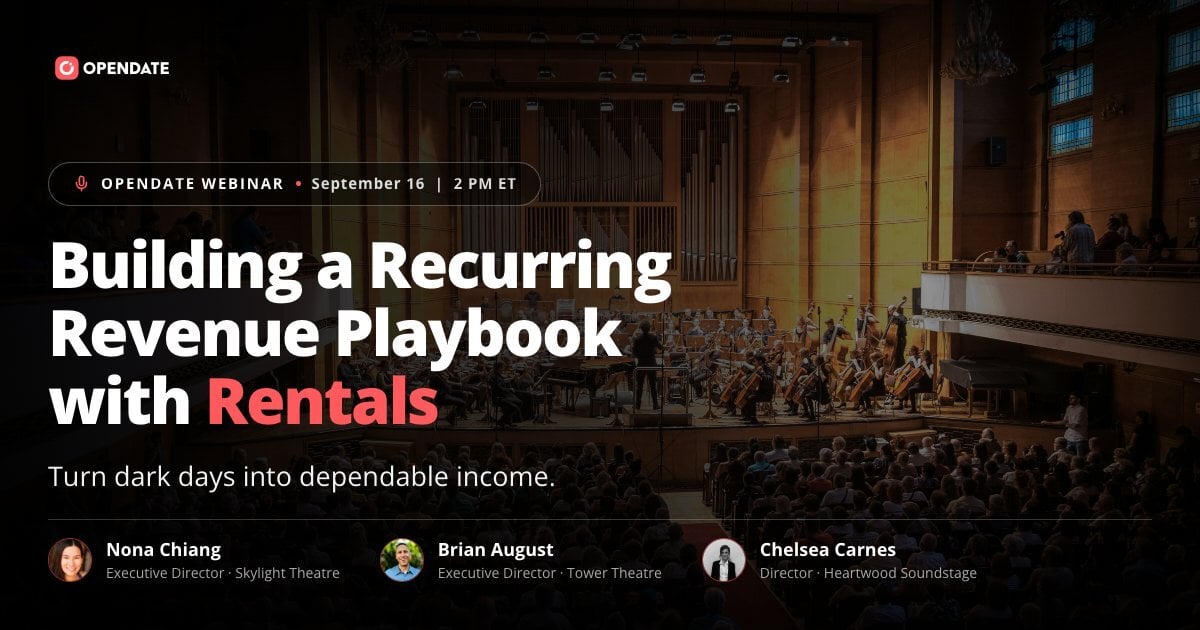
On Wednesday, September 16 at 2:00 PM ET:
Nona Chiang — Executive Director, Skylight Theatre
Brian August — Executive Director, Tower Theatre
Chelsea Carnes — Director, Heartwood Soundstage
Moderated by Alec Gaylord, Senior Sales Executive at Opendate.
A theatre, a historic room, and a multi-use soundstage — three different rental markets, three different answers to the same questions.
📅 Wednesday, September 16 at 2:00 PM ET
Can't make it live? Register anyway — we'll send you the recording.