See how Opendate can help you manage the entire event lifecycle.
Let us know who you are to unlock the demo video.
Thank you! Your submission has been received!
Oops! Something went wrong while submitting the form.


Every venue operator has had this conversation with a furious fan.
They paid $180 for a $45 ticket. Or they bought a ticket that never existed and found out at the door. Either way they're standing in your lobby, and the person who took their money is three states away behind a reseller account. You didn't set that price. You don't have their money. You get the complaint anyway.
That's the arrangement most of the live business has quietly accepted for a decade. In July, D.C. stopped accepting it.
SAVE YOUR SPOT
The D.C. Council voted unanimously to pass the RESALE Act — Restricting Egregious Scalping Against Live Entertainment. Four provisions matter:
A 10% cap on resale markups. Tickets can't be resold for more than 10% above face value. Not 110% above. Ten percent. It's the tightest cap in the country by a wide margin — Vermont passed a version earlier this year that allows a 110% increase, and that was considered aggressive at the time.
A ban on speculative ticket sales. It becomes illegal to advertise or sell a ticket you don't actually hold. This is the provision that gets the least press and causes the most damage day to day. Speculative listings are why fans show up with confirmation emails for seats that were never real.
Licensing for volume resellers. Anyone advertising more than 50 tickets in a year needs a license. That's a paper trail where there wasn't one.
Concerts, not sports. The law applies to concerts and excludes sporting events.
It still needs the mayor's signature and has to clear congressional review, which puts the expected effective date at January 2027.
This is the question worth sitting with, and the honest answer is: partly both.
A price cap is only as good as the jurisdiction it can reach. When a listing sits on a platform incorporated somewhere else, serving a buyer in a third state, for a show in D.C. — who enforces the cap, and against whom? Laws like this tend to work not by prosecuting every violation but by making the largest, most visible platforms change their default behavior in that market. That's a real effect. It's just not the same as the cap being universally honored on day one.
The speculative ticketing ban may be the more durable win. It's easier to prove — either you held the ticket when you listed it or you didn't — and it targets a practice with no legitimate defense.
The licensing requirement is the sleeper. Fifty tickets a year is a low bar, and licensing creates a registry. Registries create enforcement capacity that price caps alone don't have.
Because D.C. is a template now.
Vermont went first with a looser cap. D.C. went considerably further and passed it unanimously — not narrowly, not along party lines. Unanimous votes travel well when a legislator in another state is deciding whether a bill is safe to sponsor.
If you operate anywhere else, the useful posture isn't waiting to see whether your state acts. It's asking what you'd want already in place if it did.
Most of that list is worth doing regardless:
Know who your buyers actually are. Resale strips the fan relationship out of your hands — you sell an allotment, someone else sells to the human, and you never learn who came. First-party data is the counterweight, and it's the thing you can't retrofit after the fact.
Use presales as more than a marketing beat. A well-run presale to a list you own is the cleanest defense against the secondary market getting to your fans first.
Watch what your own distribution does. Plenty of venues are unknowingly feeding inventory into channels that end up on resale platforms.
Get your pricing closer to true demand. A wide gap between face value and what fans will actually pay is the oxygen the resale market runs on. Some of that gap is a deliberate access choice. Some of it is just leaving money on a table that a scalper is happy to clear.
None of these require a law to change. All of them put you in a stronger position when one does.
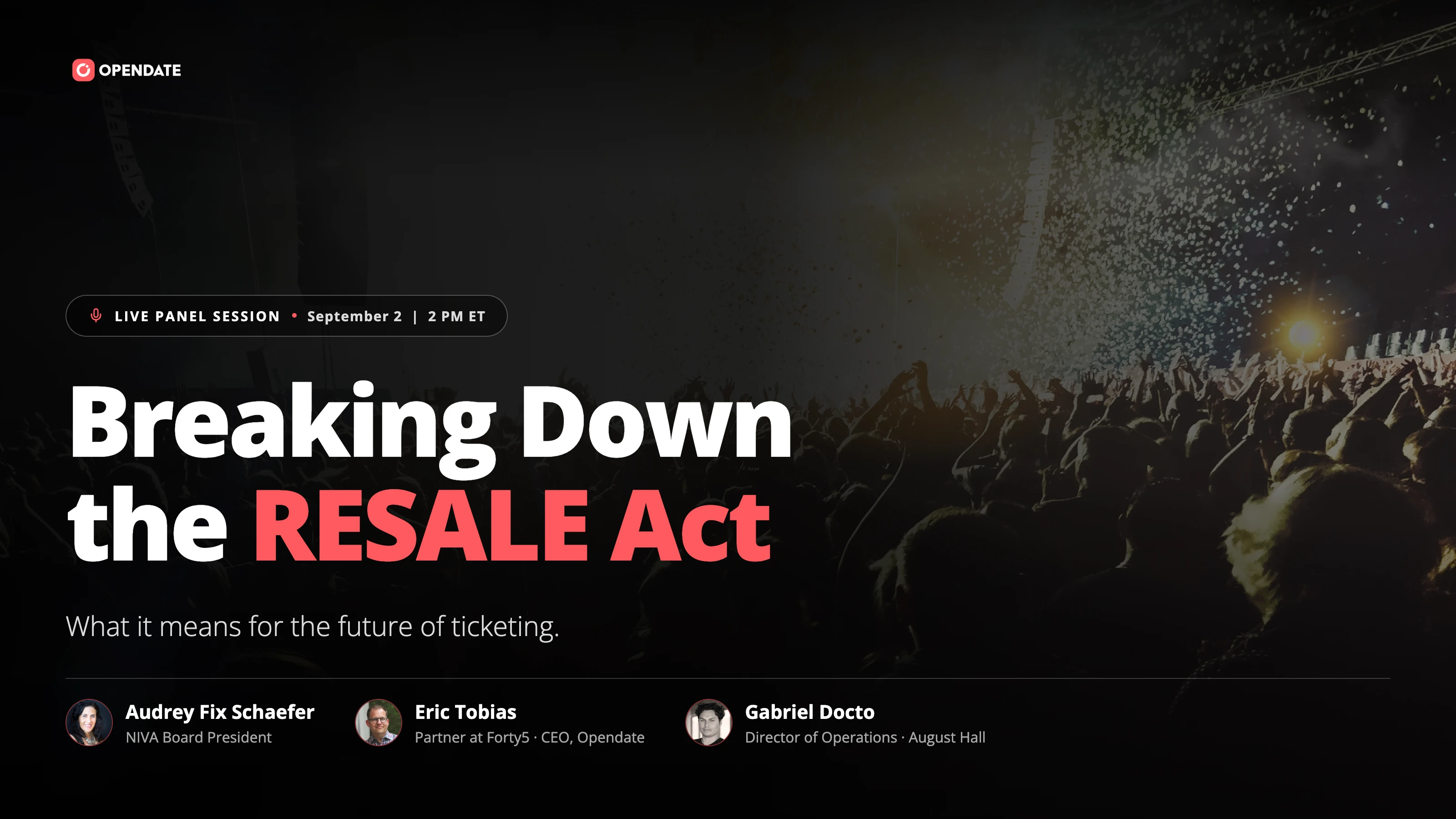
Audrey Fix Schaefer is Communications Director at I.M.P. — 9:30 Club, The Anthem, Merriweather Post Pavilion, Lincoln Theatre, The Atlantis — and Board President of NIVA. She helped lead the advocacy that got the RESALE Act across the line, after helping lead the Save Our Stages effort that secured $16 billion in relief for independent venues. When she says what it took to pass this, it's a first-hand account.
Gabriel Docto is Director of Operations at August Hall in San Francisco. He brings the operator's view of what a resale cap changes on the ground — at the box office, at the door, and in the conversations staff have with fans who paid three times face.
Eric Tobias is CEO at Opendate and a venue owner at Forty5 and The Vogue. He's approaching this from both sides — the operator who has to absorb the fan complaint, and the platform side of what venues need in order to own the relationship in the first place.
We'll get into what's in the bill, what's enforceable, what the next state's version probably looks like, and what operators should be doing between now and January 2027.
Wednesday, September 2 at 2:00 PM ET. 45 minutes, with time for your questions.
Can't make it live? Register anyway and we'll send you the recording.