See how Opendate can help you manage the entire event lifecycle.
Let us know who you are to unlock the demo video.
Thank you! Your submission has been received!
Oops! Something went wrong while submitting the form.


There's a specific feeling every operator knows. You announce a show, it catches fire, and tickets are gone in a weekend — at the price you guessed weeks earlier. The room is full, which is great. But you watch those same tickets reappear on resale at double face value, and you know exactly whose pocket that margin went into. Not yours. Not the artist's.
The standard fix has been manual: watch the on-sale, gut-check the pace, log in, change the price, hope you timed it right. Some venues do this well. Most don't have the time. Almost nobody enjoys it.
So we upgraded the tool you already use.
If you ticket with Opendate, you already use price changes — early bird steps, day-of-show bumps, scheduled tiers. Dynamic Pricing is that same system with one new skill: it responds to actual demand, automatically.
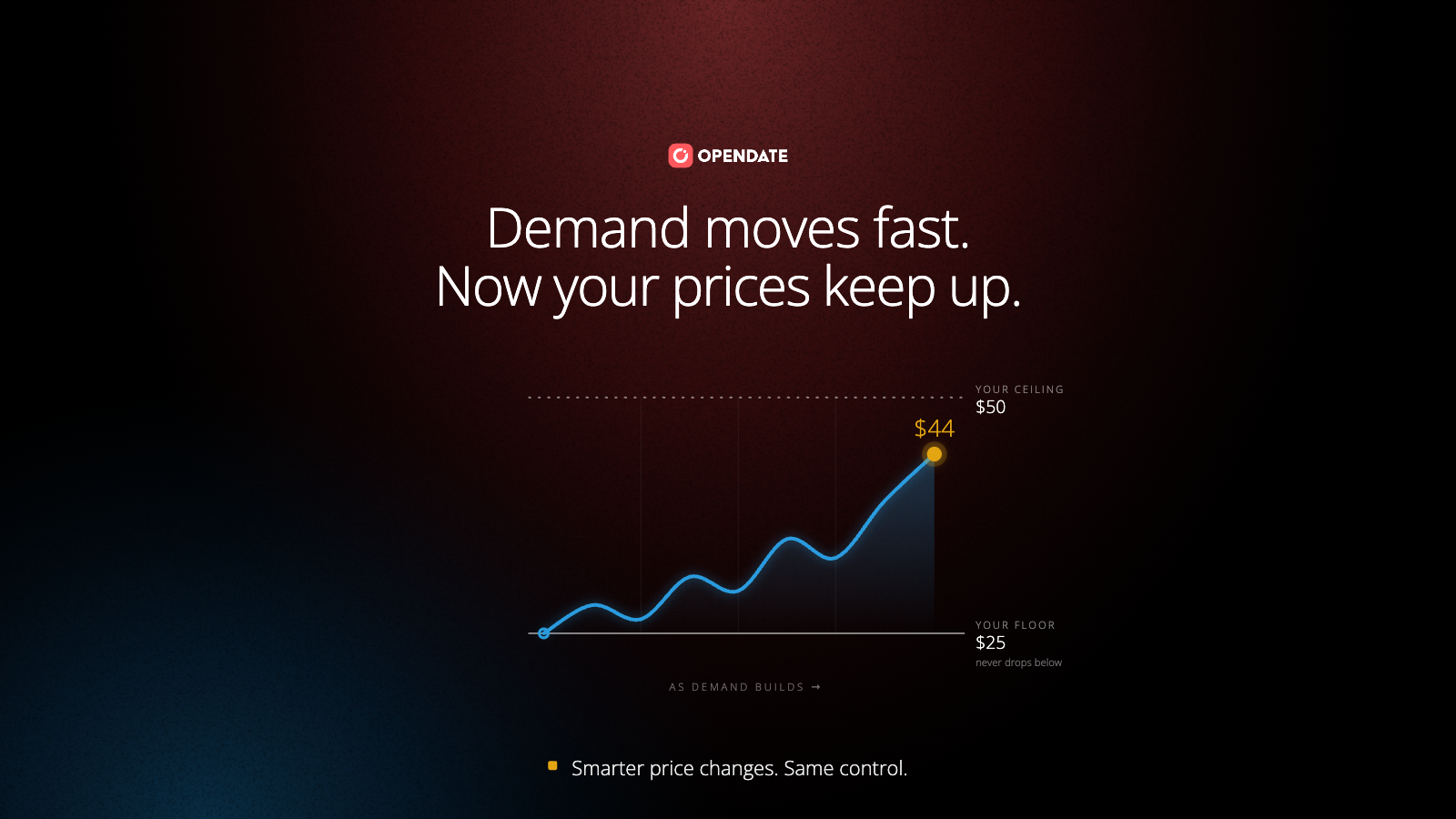
Here's how it works. On any ticket type, you set a base price and how far the price is allowed to climb — say, a $25 ticket that can go to $50. Opendate's demand engine continuously evaluates your show's sales pace and updates pricing as demand shifts. When your show runs hot, the price steps up within your limits. When it doesn't, nothing changes.
Three rules are always true:
You can also cap how many tickets sell at dynamic prices, and the whole thing works alongside reserved seating, promo codes, add-ons, and round-up pricing.
We know the reputation dynamic pricing has in live entertainment, and we built this deliberately differently. The big-platform version hands pricing to a black box and lets fans find out at checkout. Ours hands the controls to the venue.
You decide whether to turn it on, per ticket type. You decide the ceiling. You decide how many tickets it applies to. And your settlement shows every price point sold, so artists and promoters see exactly what happened — no mystery revenue.
We built the tool. You decide how to use it.
Think about your last fast sellout. If even a quarter of those tickets had stepped up $5-10 as demand spiked, what does that do to the night? For most rooms it's hundreds to thousands of dollars per show — revenue that currently walks out the door to resellers, captured instead by the people who actually booked the show, sold it, and opened the doors.
And on the slow weeks? Nothing changes. Your prices hold at base. Dynamic Pricing only works in one direction: up from your floor, within your rules.
Dynamic Pricing is available now. Set your limits on any ticket type and let your next hot show earn what it's worth.
Smarter price changes. Same control.

.avif)